Comparisons · · 16 min read
Redocly Review 2026
Redocly treats documentation as code and builds every workflow around Git. This review assesses the editor, API rendering, review process, reader assistant, and analytics through hands-on use, and explains how per-seat, per-module pricing adds up and which teams the platform suits.

Monika B.
GTM Engineer, Documentation.AI
On this page
Redocly is the platform your engineers already trust. Redoc, its open-source renderer, has been the default answer to "how do I make an OpenAPI file readable" for years, and the commercial platform is built on the same conviction: documentation is code, and code moves through Git. Everything Redocly does well follows from that, and every place it slows down is somewhere that conviction meets a person who does not write code.
Everything below comes from building on the platform and from Redocly's own pricing page, product documentation, and engineering blog, with an access date on every citation. Where we describe what other teams report, we say plainly how thin the public evidence is.
Redocly Review: The Verdict
Redocly is the platform in this category that commits hardest to docs-as-code, and the weakest one for a mixed team. Rendering, Git workflow, and governance are all excellent. Editing is a Markdown file in an IDE, every AI that writes is in early access, and the reader assistant, the analytics, and the MCP server all start at Enterprise.
Our overall score is 3.4 out of 5, the unweighted average of the eight scores below, rounded to one decimal. Every review in this series is scored on the same eight criteria, so the rows compare directly from one platform to the next.
| What we rated | Score | Why |
|---|---|---|
| Editing and structuring | 2.5 | A capable Markdown IDE, no block editor, and a pull request for every change |
| API reference and explorer | 4.6 | Redoc rendering across four specification formats, mock servers, and a Replay console |
| Published output and design | 4.0 | Clean and deeply customizable, once somebody has learned the theming system |
| AI authoring and the agent | 2.0 | Reviewer and Writer both exist, both are early access, and neither carries a price |
| Reader AI and search | 3.0 | Fast answers with sources, at Enterprise, capped at 3,500 questions per organization |
| Analytics and reader insight | 3.4 | Verbatim AI conversations and failed searches, behind the same Enterprise line |
| Governance and collaboration | 4.5 | Page-level RBAC, SSO with SCIM, real pull request review, and an SLA from the entry plan |
| Pricing and value | 3.2 | Cheap to start, and the module multiplier and the page meter decide the real number |
Buy Redocly if your API description is the source of truth, your documentation lives in a repository, engineers write most of it, and you want a review workflow that is your Git workflow rather than an imitation of one.
Look elsewhere if writers, product managers, or support leads need to edit without a pull request, you expect AI to draft or maintain content today, or you need the reader assistant and analytics without an Enterprise contract.
The honest framing is that Redocly has spent 2026 making documentation legible to machines rather than easier for humans to write. That is a defensible bet, and it is not the bet most documentation teams are making.
What Is Redocly Built For?
Redocly is built for engineering teams that treat documentation as part of the codebase. The platform assumes a repository exists, that changes arrive as commits and pull requests, and that the person writing is comfortable with Markdown, YAML, and a file tree.
The product is sold as six names, and decoding them is the first real task. Redoc is the API reference renderer, the open-source project with more than 25,000 GitHub stars, and the base of every paid plan. Revel adds Markdown documentation, React pages, localization, and multi-product support. Reef is the internal service catalog with governance scorecards. Realm is all three together. Reunite is the workspace where you edit, review, and deploy. Respect is API monitoring built on Arazzo workflows, priced separately by request. [1] Redoc, Revel, and Reef each carry the full per-seat rate, so the first three names you decode are also the three that multiply your bill.
What Redocly is not is a knowledge base, a help center, or a place where non-technical contributors write. There is no ticketing, no support deflection reporting, and no editing surface that hides the file system.
Redocly Features: What Stands Out
The Editor Is a Markdown IDE
There is no block editor in Redocly, and this is the single most important sentence in the review. You write Markdown in a file, in a pane, with a file tree beside it. A toolbar inserts headings, bold, italics, links, blockquotes, code blocks, ordered lists, unordered lists, and checkbox lists, plus six Markdoc tags: if, else, table, partial, admonition, and code snippet. [2]
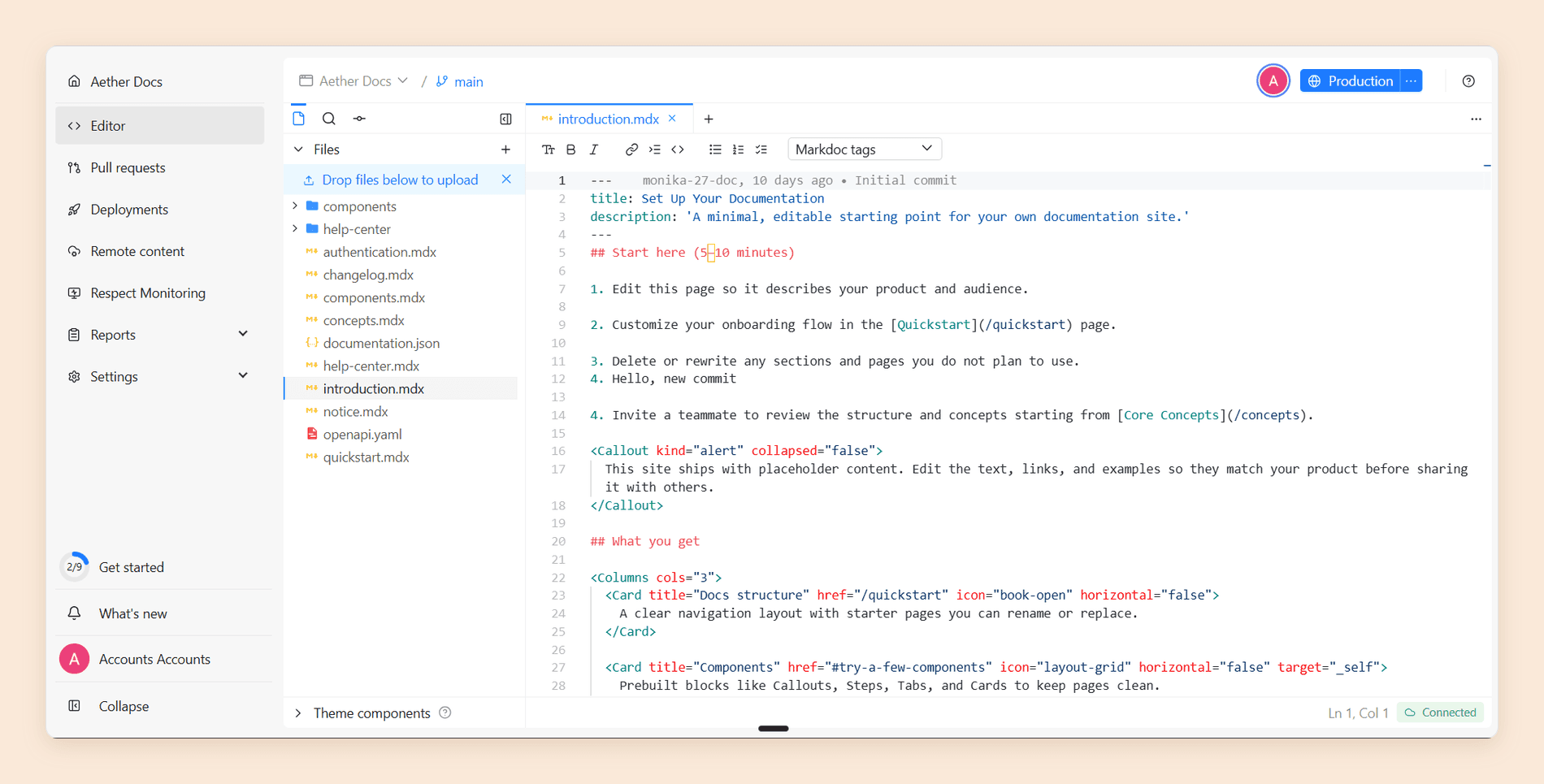
For a developer this is comfortable and fast. Tabs split into groups, search does regex and find-and-replace across folders, and you can drag an image from your desktop into a Markdown file and Redocly files it into the nearest images folder for you. [2] It behaves the way a code editor behaves, because it is one.
The component library sits behind Markdoc tags rather than a slash menu, so adding a card group or a code walkthrough means knowing the tag exists and typing it. There is a tag library in Redocly's documentation, and the editor can open that documentation in a side tab, but nothing surfaces a component while you type.
A Live Preview, the Manual, and an API Console
The utility pane carries three tabs, and using them together is what makes the daily experience work. Webview renders whatever you are editing as it would publish, updating as you type, with device presets from mobile to desktop HD and a status bar showing your page count and every build error with its location. [2] Docs opens Redocly's own documentation beside your file, so the Markdoc tag you cannot remember is one tab away rather than one browser window away. Replay is an API console for testing requests against your description without leaving the editor. [2]
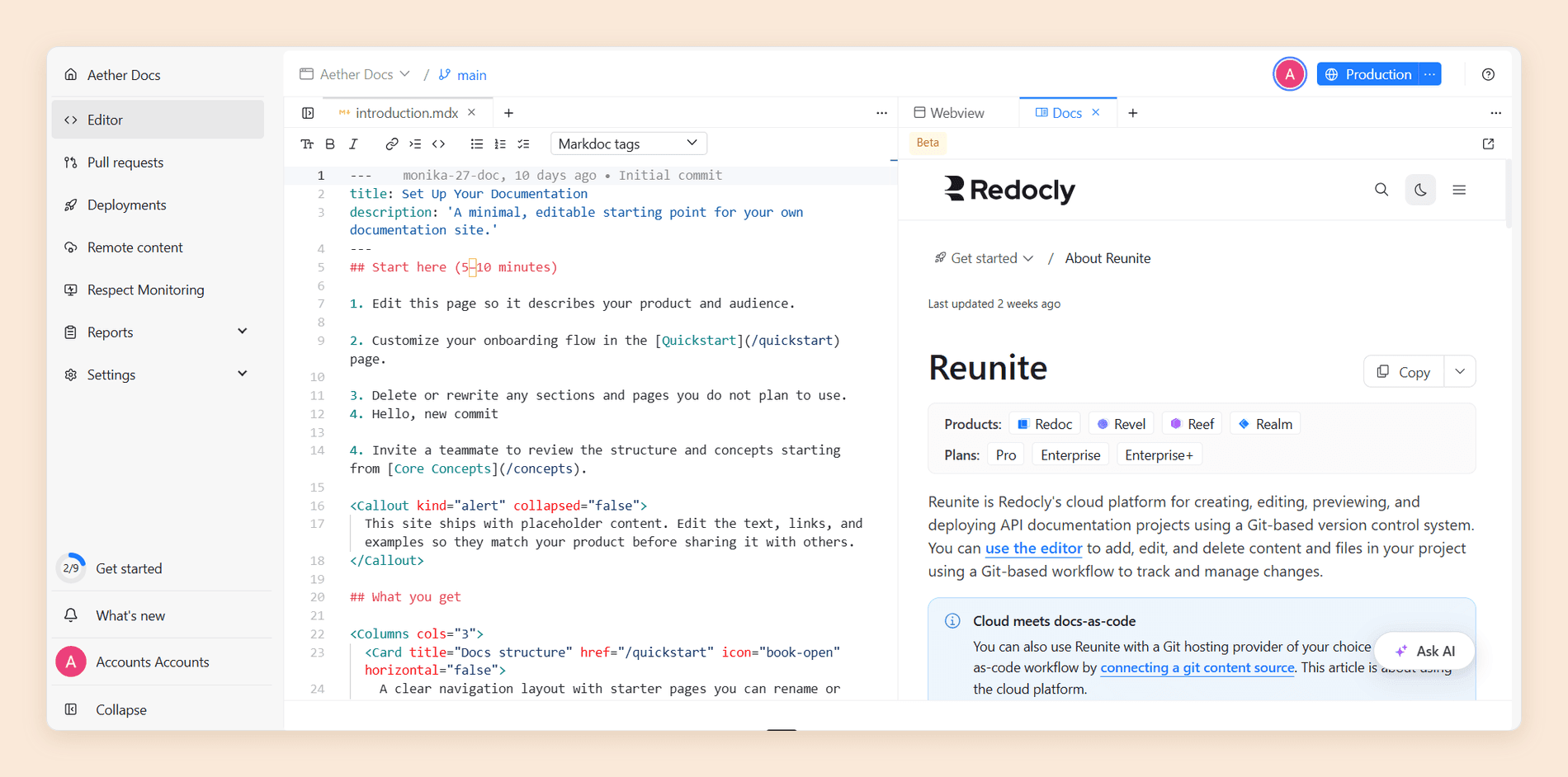
The Docs tab is labeled beta. Raw Markdown in one pane and a live Webview render in the other is where most of the work happens, and it beats the single preview pane most competitors offer. Separately, a preview deployment fires on every commit to a branch with an open pull request, and if you connected GitHub that preview appears as a check on the pull request itself. [2]
A Git Workflow That Is Actually a Git Workflow
Redocly is the only platform in this comparison with no editing surface that hides Git from you, and that turns out to be the point rather than the limitation. Branch, commit, review the diff file by file, deselect what you do not want to include, write a message, open a draft pull request. The commit history panel shows what is ahead of and behind main, with a Sync button, and hovering a commit shows the author, the message, the timestamp, and the hash. [2]
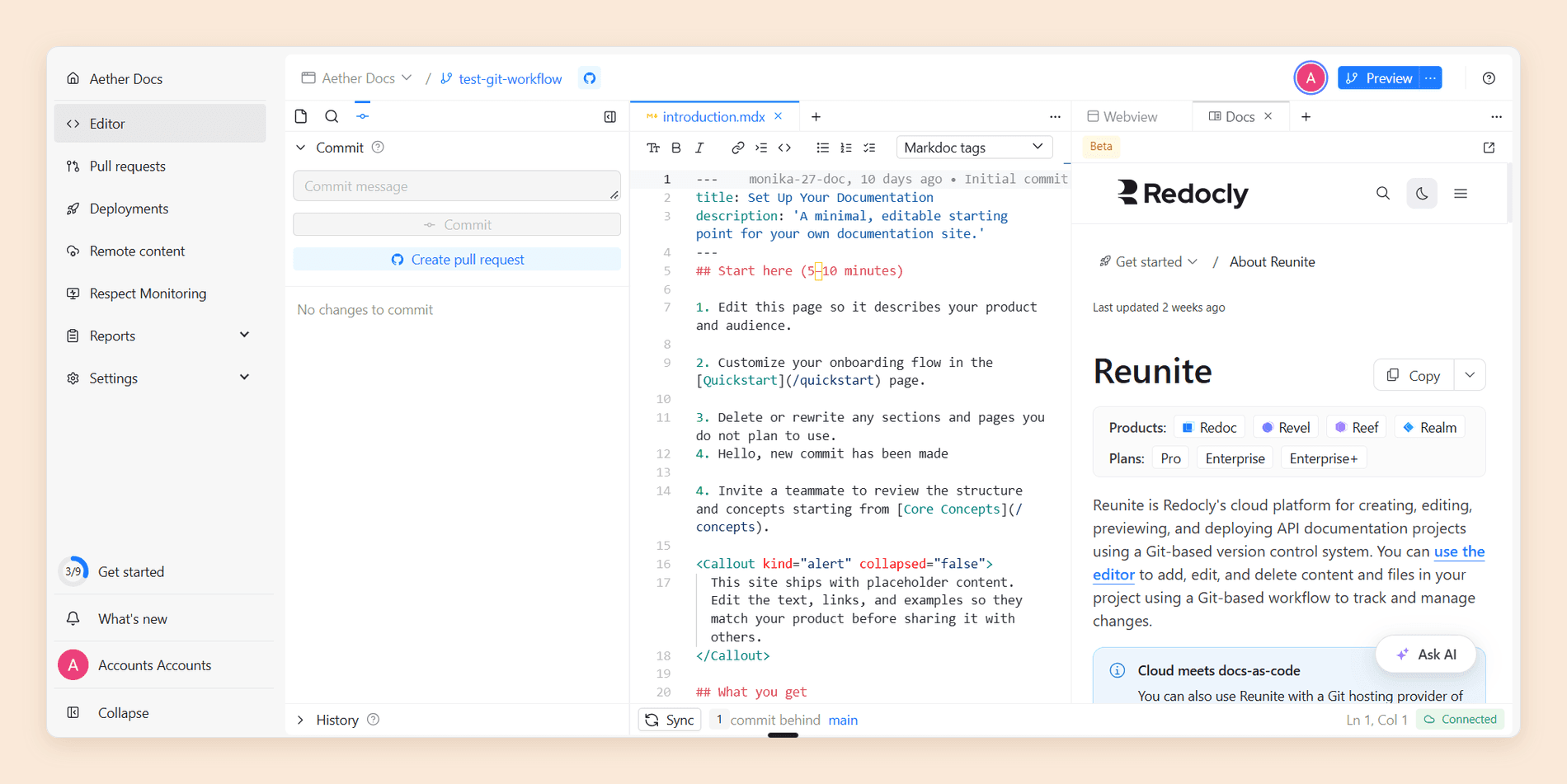
Reviewers see the rendered result rather than the raw diff, which documentation teams ask for and rarely get. Versioning is a folder convention: create subfolders starting with @, such as @latest or @1.0.0, and a version picker appears in the sidebar automatically. [2] Remote content pulls files from other repositories into the project, so a monorepo's documentation can live next to its code, though that one is Enterprise. [1]
Published Docs That AI Tools Can Actually Read
Redocly has spent 2026 on this and it shows. An Enterprise project ships an MCP server at /mcp with nothing to build and nothing to host, exposing search, API listing, and endpoint details, with your access control enforced on every call. Opening that URL in a browser gives a setup page with one-click configuration for VS Code and Cursor. [3] MCP servers are an Enterprise and Enterprise+ capability, not something every project gets. [1]
Below that line you still get llms.txt in the standard format, including OpenAPI code samples and response samples. You can drop SKILL.md files into an @skills folder so agents follow your instructions rather than guessing from reference pages, and the project publishes MCP and A2A agent cards so agents can discover it on their own. [2] [3] Page actions let a reader copy any page as Markdown or hand it straight to ChatGPT or Claude, and on Enterprise the same menu offers to install your docs MCP server in Cursor or VS Code.
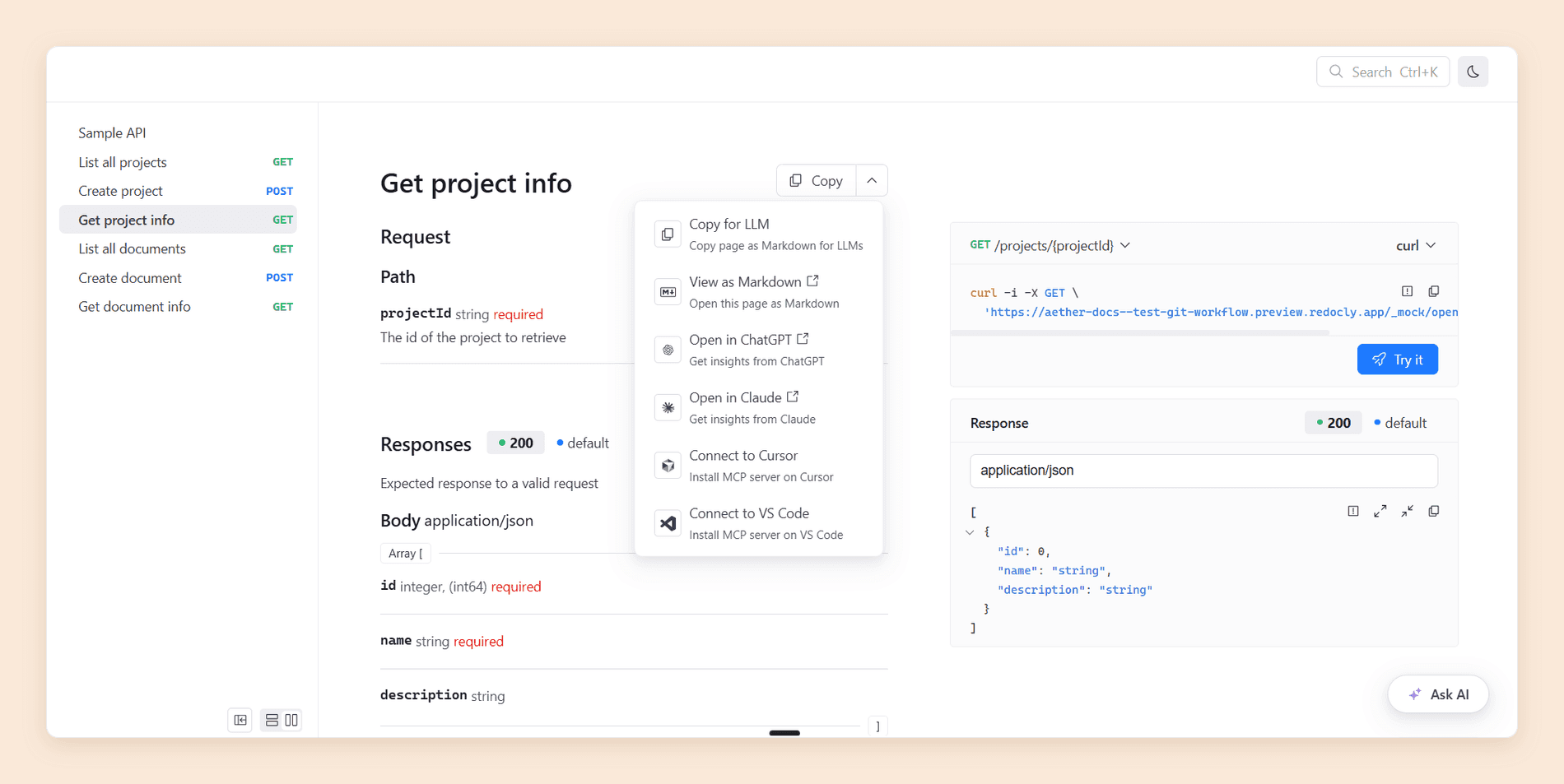
If your worry is that developers now ask an assistant before they open your documentation, Redocly has an unusually complete answer. That answer is publishing infrastructure for machines, not help for the person writing the page.
Ask AI on the Published Site
The reader-facing assistant is good. It answered fast, in complete sentences, and cited the pages it drew from, which is the behavior that decides whether readers trust it. You can configure suggested questions, set a hidden system prompt that shapes tone, and choose whether it appears as a floating button or an icon. [2]
It comes with limits. It is available on Enterprise and Enterprise+ only, with 3,500 questions per organization per month, after which readers get ordinary search results instead of answers. [2] And its index only builds on the production branch, so a search configuration change does not take effect until your next production deploy. [2]
Where Redocly Slows Down
Six things to weigh: two structural choices Redocly has made deliberately, two plan boundaries, a set of limits that block rather than bill, and how little independent evidence exists to check us against.
Non-Technical Contributors Are Effectively Locked Out
A product manager who spots a wrong sentence cannot fix it. They can learn the file tree, find the Markdown file, edit it, commit to a branch, open a pull request, and wait for a review. Or they can send the correction to an engineer. Most stakeholders will take the second option, and the documentation then ages at the speed of engineering attention.
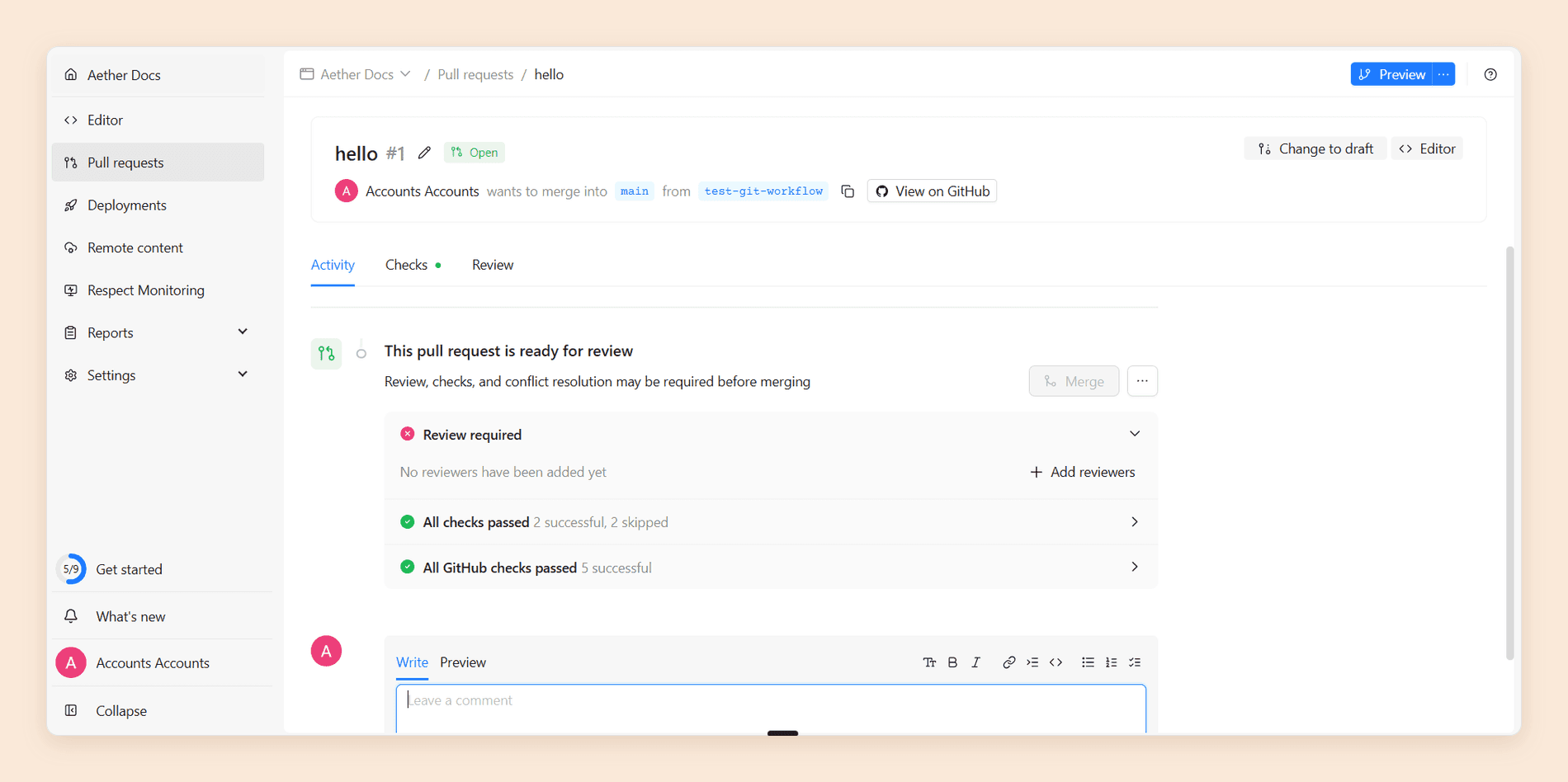
This is the complaint that recurs most often about Redocly, and it is true by design rather than by omission. The editor is very good at what it does. What it does is edit files.
The learning curve compounds it. Customizing the published site means learning Redocly's theming system, its CSS variables, and its component ejection model, and that is a skill rather than a settings page. Budget more time for a polished site than the templates suggest.
Every AI That Writes Needs Redocly's Permission
There is no AI writing assistant in the editor. Nothing drafts a page, expands a paragraph, or turns your spec into prose while you work, and Redocly's own positioning is explicit about why: "AI writes. Redocly verifies." [3] You prompt your own model somewhere else and bring the result back for linting and review.
Redocly Agent does have a writing half. Writer turns user feedback and analytics into proposed changes and opens draft pull requests. Reviewer is the more interesting product: it comments line by line when a pull request opens, checking API descriptions for breaking changes, Markdown against the OpenAPI it references, security risks framed by the OWASP API Security Top 10, and contradictions between pages, and it never blocks a merge. Redocly reports more than 11,900 issues surfaced across 1,700 pull requests in early access, with about 40 percent fixed. [3]
Now the catch, and it applies to both halves. Reviewer and Writer are early access, off by default, enabled per organization by Redocly, and priced nowhere. [3] You cannot switch either on yourself, and you cannot budget for them.
The gap is worth naming precisely. Writer is designed to work from search queries, feedback, and page analytics, which are exactly the signals Redocly only shows you on Enterprise. The agent that fixes your documentation runs on reports you have to upgrade to see.
Separately, the AI Assistant inside Reunite answers questions about your Redocly setup: your plan, your members, your build logs, your configuration. [3] Genuinely useful for "why did my build fail", and not a writing tool.
Analytics Exist, and They Are Enterprise Only
Redocly's analytics are better than we expected and further up the price list than most buyers expect. You get page views and unique users with a top-pages table, referring domains, and CSV export. You get search queries with a Most not found filter, which is a list of what your documentation is missing, written by the people who needed it. And you get AI Assistant conversations expanded to the full question, the answer, and the sources, with likes and dislikes. [2] A separate Feedback report collects page-level feedback and code snippet reports with a status workflow. [2]
That is a strong set, and the pricing page lists Analytics under Enterprise, so at $10 per seat you publish blind. [1] Two smaller catches sit underneath. Analytics depends on telemetry, so setting REDOCLY_TELEMETRY to off in production silently produces an empty dashboard. [2] And only project admins and maintainers can see it, so a writer without that role cannot see how their own pages perform. [2]
Search, SSO, and Access Control Are the Same Boundary
Every project gets FlexSearch. Typesense, which adds result curation, facet counts, and weighted title ranking, is Enterprise and Enterprise+ only. [2] So are SSO, guest SSO, RBAC, remote content, MCP servers, analytics, and the AI assistant. [1]
That is one line, and almost everything a 2026 buyer shortlists on is behind it. Pro is the renderer plus a workspace, with one project, 100 pages, custom domain hosting, and Reunite, so most serious evaluations should price the $24 seat rather than the $10 one. [1]
Credit where it is due on one point the category usually gets wrong. Redocly's SLA sits in the standard subscription agreement rather than an Enterprise addendum, so 99.9 percent uptime and an average 24-hour support response apply from the entry plan up. [1] Very few competitors here commit to anything below Enterprise.
Every Limit Blocks Rather Than Bills
Redocly's limits do not add an overage line to an invoice. Pages are the only metered item, and the other two quotas are bought in advance, so all three are worth modeling before the trial ends. [2]
Seats count committers. Any committer active in the last 30 days who is not linked to a member account takes a paid seat, so an engineer who once pushed to the docs folder is billed, and counted twice if they use a second email address. Once the seats are used up you cannot invite anyone else, and on SSO with just-in-time signup a new user cannot log in. Readers and viewers stay free. [2]
Pages count API operations. Every operation in your OpenAPI description is a page, against an allowance of 100 on Pro and 500 on Enterprise, and the running count sits in the editor's status bar. [2] This is the one limit that stops deployments.
Projects do not scale with the plan. One is included on every tier, so a second documentation website is a purchase at any price, and you cannot create one until you have bought it. [2] Our Redocly pricing guide prices all three meters in full.
One More Thing, and It Is About the Evidence
Redocly has no Capterra listing, no Trustpilot profile, and zero user reviews on SourceForge and Slashdot. The public record is developer forums, competitor comparison pages, and tool directories, and the same observations recur across them: excellent rendering, unmatched ecosystem support, a dated dashboard, confusing product naming, costly customization, and a per-seat bill that grows at scale. That is consistent enough to take seriously and thin enough that your own trial is the evidence that counts, so use all 30 days of it.
Redocly Pricing
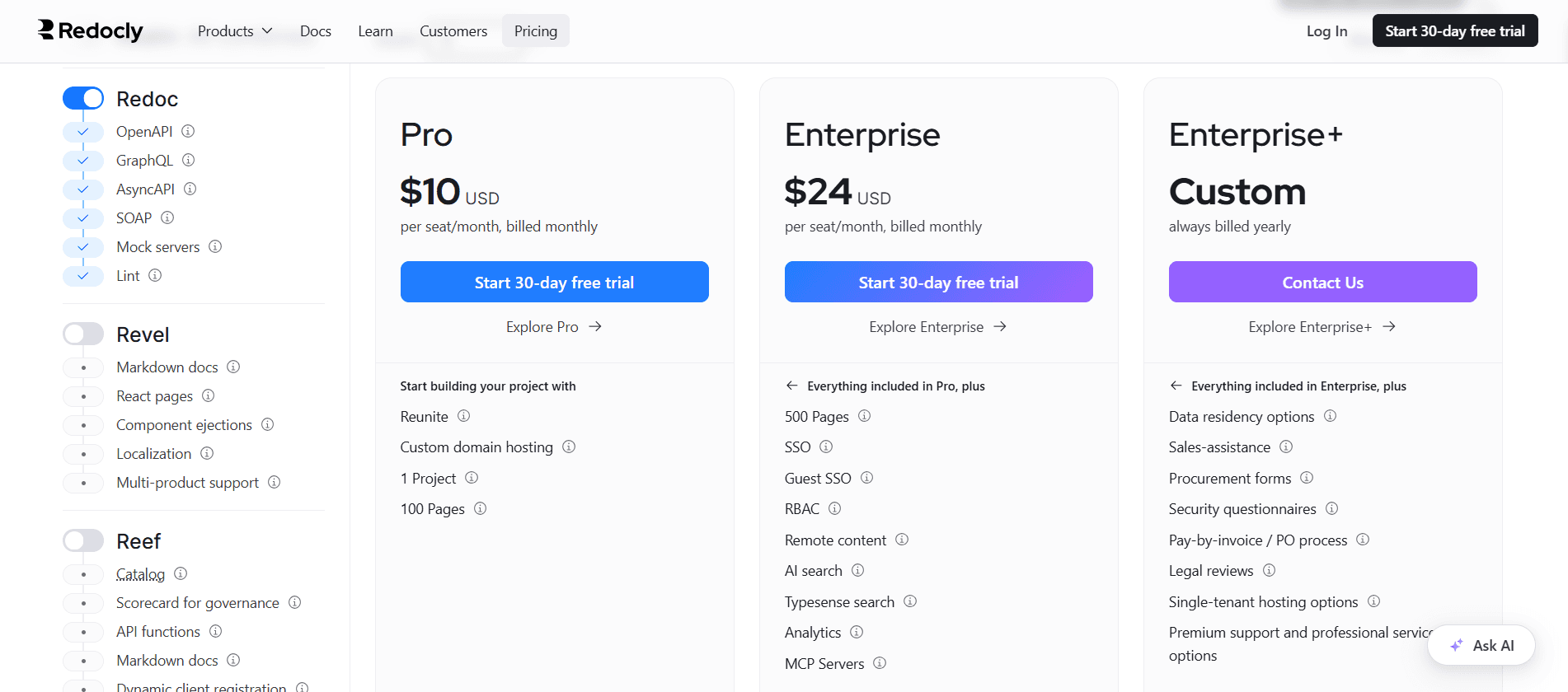
Redocly has three plans, no free tier, and a per-seat rate that is multiplied by the number of product modules you switch on rather than added to. Pro starts at $10 per seat a month and Enterprise at $24, and both are self-serve with a checkout button. [1]
| Plan | One module | Two modules | Realm, all three |
|---|---|---|---|
| Pro | $10 per seat/mo | $20 per seat/mo | $28 per seat/mo |
| Enterprise | $24 per seat/mo | $48 per seat/mo | $66 per seat/mo |
| Enterprise+ | Custom quote | Custom quote | Custom quote |
Billed annually, the same seats run $108, $216, and $300 a year on Pro, and $264, $528, and $708 on Enterprise, which is 8 to 11 percent off the monthly rate. Enterprise+ is always billed yearly. [1]
Beyond the meters above, modules decide your real number. Redoc renders your API description and nothing else, with nowhere to put a getting-started guide, so adding Revel for Markdown pages takes Pro from $10 a seat to $20. [1]
The number to plan against is not $10. For a team of five that wants Markdown documentation alongside its API reference and a reader assistant, that is Enterprise with two modules, or roughly $220 a month billed annually, before a single page over the allowance.
Our Redocly pricing guide takes the whole rate card apart, including the Enterprise volume bands, the page and project overage rates, what the 30-day trial includes, and worked bills for five real teams.
Does It Fit Your Team?
It turns on two questions: does everyone who needs to edit your documentation already work in Git, and do you need to see how readers use the result?
| Your situation | Fit | What decides it |
|---|---|---|
| API-first product, engineers own the docs | Excellent | The review workflow is your Git workflow, with nothing in between |
| OpenAPI, GraphQL, AsyncAPI, or SOAP in the estate | Excellent | All four render, and Redoc handles them properly |
| Docs live in the same repository as the code | Excellent | Branch previews and provider status checks were built for exactly this |
| You want your docs readable by AI agents | Good | llms.txt, agent skills, and agent cards on any plan, MCP at Enterprise |
| Strict access control, SSO, or data residency | Good | RBAC to the page level and SCIM, at Enterprise and above |
| Writers or product managers edit daily | Poor | Markdown files, and a pull request for every change |
| You expect AI to draft or maintain content | Poor | Reviewer and Writer are early access, off by default, and unpriced |
| Reader analytics on a small budget | Poor | Views, queries, and AI transcripts are all Enterprise |
| A large API and a small budget | Poor | Each operation is a page, against 100 on Pro and 500 on Enterprise |
| Many engineers touch the docs repository occasionally | Mixed | Committers consume seats, and once they are used up nobody else can be invited |
Before you sign, get answers to these:
- Who writes documentation today, and how many of them have opened a pull request in the last month?
- Which of Redoc, Revel, and Reef do you actually need, and what does that multiply out to per seat?
- How many operations are in your API description, since each one spends a page from your allowance?
- How many people have committed to your docs repository in the last 30 days, and does that number fit your seat count?
- If the answer to a documentation question is currently "ask an engineer", what changes here to fix that?
Is Redocly Worth It in 2026?
Yes, if your documentation is code and the people writing it are engineers. Redocly's API rendering is among the best in this comparison, its Git workflow is the real thing rather than an imitation of one, and its agent-facing publishing is unusually complete. For that team, an entry rate of $10 a seat is a good deal.
That answer holds only if three things are true.
Editing is a developer skill here, and that is permanent. There is no visual editor on the roadmap and no path for a non-technical contributor that avoids a pull request, so if writers own your documentation, no plan upgrade makes this the right platform. [2]
AI helps your readers, not your writers. The published assistant is good, but Reviewer and Writer are early access and priced nowhere, so AI authoring is a request form rather than a purchase. [3]
The bill is a configuration, not a price. Modules, plans, pages, projects, and committers all move it, and every limit blocks rather than adding a line to an invoice. [1] [2]
Our verdict stands at 3.4 out of 5, the lowest in this review series and the highest we would give it for the team it was built for. The difference between those two readings is whether your writers use Git.
Best Redocly Alternative
The closest alternative on capability is Documentation.AI, and the difference is who is allowed to write. Both run a Git workflow, publish an assistant on the docs, and expose content to AI tools. Only one of them lets a writer edit and publish without a commit.
Switches usually come down to three differences. Editing is visual as well as Markdown, so a product manager can fix a sentence without a pull request. Reader AI is on the free Starter plan with 10,000 credits rather than being an Enterprise feature with a monthly answer cap. And seats are unlimited on the Pro plan at $159 a month, which removes both the per-seat arithmetic and the rule that turns a passing committer into a paid seat. [2] [4]
Redocly still wins on three counts worth naming. It is the only platform here where the documentation review is the same pull request review your engineers already run, with no sync layer and no second copy of the content. Reviewer, its pull request agent, has no equivalent in this comparison at all. And it renders SOAP alongside OpenAPI, GraphQL, and AsyncAPI, which almost nothing else in this field will do. [1] [3]
If neither fits, the field splits cleanly. Mintlify is the pick for API-first documentation where the team wants docs-as-code with a visual editor on top. GitBook is the pick for one collaborative site where a block editor matters most. ReadMe is the pick for developer portals that need per-key usage metrics. Our Theneo review covers an API-first portal builder billed per workspace, and our Archbee review covers a knowledge portal that keeps customer guides, internal docs, and an API reference in separate spaces.
| Platform | Pricing model | Editing without Git | Best for |
|---|---|---|---|
| Redocly | $10 to $66 per seat/mo, by plan and module [1] | No, Markdown and a pull request | API references owned by engineers |
| Documentation.AI | $159/mo Pro, four projects, unlimited seats [4] | Yes, visual and Markdown | Mixed teams keeping several docs sets current |
| Mintlify | $450/mo Pro, unlimited editor seats [5] | Yes, visual mode with Git sync | API-first developer docs |
| GitBook | $65 or $249 per site/mo, plus $12 per user/mo [6] | Yes, block editor | One collaborative docs site |
| ReadMe | $250/mo Pro, one project, Ask AI $150/mo extra | Yes, hosted editor | Developer portals with usage metrics |
Redocly's rates are the monthly figures it publishes. The other four are the annual rates each vendor publishes.
Working out which plan you would actually land on?
Book a demo and we will price your real team: how many writers, how many committers, how many products, and what each platform charges for them.
Documentation.AI Slack channel: Join here
Deeper on each:
- Redocly pricing 2026, the seats, modules, and meters priced out in full
- Redocly vs Documentation.AI, the same documentation built on both platforms
- API documentation tools, the whole category compared at once
- Developer documentation tools, what engineering-owned documentation actually needs
FAQs
1. How Much Does Redocly Cost in 2026?
Pro is $10, $20, or $28 per seat a month for one, two, or all three modules, and Enterprise is $24, $48, or $66, with lower rates on yearly billing. Enterprise+ is a custom quote. There is no free tier, and our Redocly pricing guide works through the meters on top. [1]
2. Does Redocly Have a Free Plan?
No. The hosted platform offers a 30-day trial. What is free is open source: the Redoc renderer and Redocly CLI, which render, lint, and bundle an OpenAPI description without an account. [1]
3. Can Non-Technical People Write Documentation in Redocly?
Not comfortably. The editor is a Markdown file editor with Markdoc tags and no visual mode, and every change goes through a pull request before it publishes. A writer can learn it. A stakeholder making an occasional correction will not. [2]
4. Does Redocly Have AI Writing Features?
Not ones you can turn on. There is no writing assistant in the editor. Redocly Agent's Writer and Reviewer roles exist, but both are early access, off by default, enabled per organization by Redocly, and priced nowhere. [3]
5. Does Redocly Have Analytics?
Yes, on Enterprise and above: page views, top pages, referring domains, failed searches, and full AI assistant conversations, exportable to CSV. It depends on telemetry being enabled, and only project admins and maintainers can see it. [2]
6. Which Git Providers Does Redocly Support?
GitHub, GitLab, Azure DevOps, and Bitbucket Cloud, plus self-managed GitLab and GitHub Enterprise as separately registered instances. You can connect a whole repository or a single folder inside one, and for self-hosted providers Redocly publishes the IP addresses you need to allow through. [2]
7. What Counts as a Seat in Redocly?
Any Owner or Member, plus any committer active in the last 30 days who is not linked to one of those accounts. Viewers, billing contacts, and readers are free, and once the seats are used up you cannot invite anyone else until you buy more. [2]
8. How Does Redocly Count Pages?
Every route in your published site is a page, and each operation in your API description is a route. Pro includes 100 pages and Enterprise 500, and past the allowance deployments stop rather than billing you. [2]
Sources
- Redocly. "Pricing." Redocly. Accessed September 2026. https://redocly.com/pricing
- Redocly. "Redocly Docs." Redocly. Accessed September 2026. https://redocly.com/docs
- Redocly. "Redocly Blog." Redocly. Accessed September 2026. https://redocly.com/blog
- Documentation.AI. "Pricing." Documentation.AI. Accessed September 2026. https://documentation.ai/pricing
- Mintlify. "Pricing." Mintlify. Accessed September 2026. https://mintlify.com/pricing
- GitBook. "Pricing." GitBook. Accessed September 2026. https://www.gitbook.com/pricing
Docs stuck behind a PR?
Writers who can ship without one
Import your Markdown from Git, then let writers edit and publish without opening a pull request.
Start freeNo credit card required