Comparisons · · 24 min read
Mintlify vs Redocly: Detailed Review and Comparison (2026)
Both platforms keep your documentation in Git, publish an API reference, and sell a reader assistant. They disagree on almost everything else: who is allowed to write, what gets metered, and how much of the product your plan actually turns on. We built the same documentation on each and priced what a real team pays.

Monika B.
GTM Engineer, Documentation.AI
On this page
- Quick Decision Guide
- How These Platforms Were Compared
- Onboarding: Which Gets a Team to a Live Site Faster?
- Writing and Maintaining Docs: Mintlify's MDX vs Redocly's Spec-First Workflow
- AI Capabilities in Real Usage: Assistants, Agents, and What Each Tier Unlocks
- Pricing: What Mintlify and Redocly Actually Cost
- Public Documentation Experience
- Pros and Cons
- Head to Head Comparison: Mintlify vs Redocly
- Final Take
- FAQs: Mintlify vs Redocly
- Sources
Mintlify and Redocly reach the same shortlist from opposite directions. Mintlify is a documentation product that learned to read OpenAPI. Redocly is an API tooling company, built around Redoc and a linter that many teams already run in CI, that grew a documentation platform outward from the specification.
That history explains most of the differences. Mintlify treats the page as the unit of work and sells one plan that includes the writing, the assistant, and the analytics. Redocly treats the specification as the unit of work and sells seats, multiplied by how many of its three modules you switch on, with a page budget underneath.
Every price and capability below comes from each vendor's current pricing page and product documentation. Where we describe how something behaved, that is our own build on both platforms, and we say so.
Quick Decision Guide
Three variables decide this one: who on your team is allowed to publish, how many of them there are, and what happens when you reach a limit.
Mintlify may be the better fit when:
- Writers, support staff, or product managers need to publish without learning branches and commits, because the browser editor runs the Git operations for them [2]
- Your editing team is growing, since seats are unlimited on the paid plan while Redocly bills every contributor [1] [4]
- The documentation has to match your product's design, because custom CSS and JavaScript are on every plan including free [1] [2]
- Your site is large, or your API is, since pages are never counted and Redocly meters them by route [2] [4]
- You want merged code to update the documentation rather than someone remembering, which automations do on four triggers [2]
Redocly may be the better fit when:
- Your API surface is wider than REST, across OpenAPI, GraphQL, AsyncAPI, and SOAP, with mock servers and linting in the same toolchain [5]
- Your code sits in Bitbucket Cloud, Azure DevOps, or a self-hosted provider, which few platforms in this category support [5]
- Engineering owns the documentation outright, so a mandatory pull request costs you nothing and buys you review [5]
- You want an AI reviewer reading every pull request for breaking changes and contradictions between pages [5]
- Your team is small and governance matters, because role-based access control and audit trails carry a published seat price rather than a sales call [4]
Bottom line: Mintlify charges for the site and puts nearly everything on one plan. Redocly charges for the contributor and holds a longer list behind Enterprise. A small engineering team that needs governance pays less on Redocly, which also publishes its Enterprise rate instead of quoting it. Add contributors, pages, or a writer outside engineering and the arithmetic turns over, which the pricing section works out seat by seat. If neither shape fits the team you actually have, Documentation.AI prices the plan rather than the seat or the page and puts the reader assistant on its free tier. Our Mintlify vs Documentation.AI and Redocly vs Documentation.AI comparisons run each against that model. Start free.
How These Platforms Were Compared
We built the same documentation on both platforms, using the same OpenAPI description and the same page tree, and compared six things:
- Signup, setup, and the route to a live site
- Writing a page, then restructuring the site around it
- The AI on both sides, authoring and reader-facing, and what each plan buys
- The published reading experience, including search and the API reference
- Total cost at the tier a working team would actually buy
- What each platform does when you reach a limit
Each section reports what each platform did, then what that difference costs you in practice. Where something is missing we say whether the product cannot do it or your plan simply does not include it, because between these two it is nearly always the second. For each platform assessed on its own, see our Mintlify review and Redocly review.
Onboarding: Which Gets a Team to a Live Site Faster?
Neither platform asks you to sign up with a Git provider, and both reach a live site inside an afternoon. The difference is what each one assumes you already have, and how long you are allowed to keep what you build.
Mintlify
Signup runs through Google or email and ends on a single fork: point Mintlify at a GitHub repository, or start from a template. We pointed it at an existing repository and got back a configured site with the navigation and page tree intact.
The repository never recedes afterwards. Pages live as MDX files, docs.json holds the structure, a new branch becomes a draft pull request, and publishing writes a commit. Writers can ignore all of that until something breaks [2].
GitLab works, but no app exists to install, so you issue a project access token and wire up the webhook yourself [2].
Nothing expires. The site you build while evaluating stays yours, and the free plan carries no AI beyond a 14-day trial grant [1].
Redocly
Signup takes email and password, Google, or your organization's SSO. Onboarding asks who you are and what the documentation is for, then uses the answers to shape what it builds.
Creating an organization opens a 30-day trial with every feature unlocked and no credit card. Redocly offers no other free access, and the trial hands you the Enterprise tier, so the assistant, the analytics, and the MCP server you test on it are not on the entry plan you may then buy [4].
Then you choose a project template, from a multi-sidebar starter down to a near-empty minimal one, and either connect a repository or take one Redocly provides on a Redocly domain.
Git support covers GitHub, GitLab, Bitbucket Cloud, Azure DevOps, and self-hosted providers, all treated as first-class [5]. Our GitHub connection took under a minute and the generated site arrived with navigation wired up.
Verdict: Redocly onboards a team that arrives with a repository more smoothly, and its provider coverage alone can settle the purchase for anyone on Azure DevOps or self-hosted GitLab. Mintlify onboards everyone else more smoothly, and it lets you evaluate properly: publish a real site, hand it round the team, keep it indefinitely, pay nothing. Both fail the same test, though. Mintlify's free plan ships no AI past the trial, and Redocly's trial ships all of it and then withdraws most of it unless you buy Enterprise, so neither lets you live with a reader assistant on a real budget before committing.
Writing and Maintaining Docs: Mintlify's MDX vs Redocly's Spec-First Workflow
Both platforms store pages as Markdown in a repository, so the old block-editor-versus-docs-as-code framing does not apply. What separates them is whether a browser editor exists at all, what happens when an edit becomes a reorganization, and how much ceremony sits between a typo and a published fix.
Mintlify
Writers get a visual surface and engineers get raw source, both in the browser and both over the same MDX file, with live cursors, comments, suggestions, and a diff view. Dragging reorders the navigation, so reshaping the site no longer means hand-editing a config file [2].
The local tooling covers the rest. mint gives you a preview server, project scaffolding, tree-wide MDX formatting, build errors caught before they ship, broken-link detection, and a warning when your checkout has drifted from production. Extensions cover VS Code, Cursor, and JetBrains [2].
Ordinary MDX in an ordinary repository means your existing habits transfer intact: project-wide replace, scripted bulk edits, linting, CI. It also means leaving is a file move rather than an extraction.
Governance is the gap. Role-based access control and audit logs both sit at Enterprise, so on the standard paid plan anyone who can open the repository can publish to production [2].
Redocly
There is no block or visual editor in Redocly at any price. Everything is Markdown, and everything is Git.
Reunite recreates an engineer's local setup in a browser tab: a file tree, tabbed files you can split into groups, and a toolbar for Markdown formatting plus Markdoc tags such as conditionals, tables, partials, and admonitions. Project-wide find and replace accepts regular expressions, which says plainly who this editor expects to find using it [5].
Webview renders uncommitted work at phone, tablet, and desktop widths, with a status bar showing build errors you can expand into a broken-link list, next to your running page count against budget. Replay fires live requests at API functions in the same window. The tab marked Documentation opens Redocly's own manual rather than your project, which catches people out on a first pass [5].
Publishing keeps the full ceremony: branch, commit, pull request, merge. Previews attach once a branch has an open pull request, arriving as a check on that pull request [5].
Reorganizing means moving files. Nothing models the navigation above the tree, so a moved section drags sidebar edits and hand-written redirects along with it. The link checker catches the damage, though only once it is done.
Verdict: Redocly takes the editor for the person it was built for, with regex find and replace, a Webview carrying a build error pane, a Replay tab, and a mandatory pull request that enforces the review Mintlify leaves optional. Mintlify takes everything above the page and everyone else, since restructuring is a supported drag rather than a file move, the local loop catches breakage before a merge, and someone who does not write Markdown can still publish. If your writers already open pull requests, Redocly's editor costs you nothing and buys you discipline. If they include a support lead or a product manager, it costs you a contributor. For a genuinely mixed team, Documentation.AI publishes from a browser for people who will not open a terminal and syncs two ways with GitHub or GitLab for people who live in one, writing to the same source either way. See how setup works.
AI Capabilities in Real Usage: Assistants, Agents, and What Each Tier Unlocks
Both platforms have invested heavily here and reached opposite conclusions about what AI is for. Mintlify wants it to write and maintain your documentation. Redocly states its position in four words, "AI writes. Redocly verifies.", and that choice shapes what each one ships. One thing they agree on is the machine audience: both publish an llms.txt and an MCP server so that AI agents answering on your readers' behalf can read the documentation directly, though Redocly's MCP server waits for Enterprise [2] [4].
Mintlify
The assistant sits on your published site, uses tool calling rather than plain retrieval, cites sources with navigable links, and pulls method, parameter, and schema detail straight from your OpenAPI description. Indexing happens on publish, which catches people out before a demo: draft branches and previews never get indexed, and hidden pages stay out unless you change the indexing setting in docs.json [2].
The agent researches, plans, writes, validates against the CLI, then opens a pull request instead of touching your live site. Work reaches it as a prompt, a pull request, a Slack thread, or an attached file, and it reads source from any repository carrying the Mintlify GitHub App. Navigation and docs.json sit within its reach too. The panel still carries a beta label [2].
Automations run that agent on four triggers: content updates, code changes, a schedule you set, and integration events, with the last held for Enterprise and each automation capped at 500 runs a day [2]. The merge that invalidates a page can be the same event that repairs it.
Credits were repriced recently, so check the date on anything quoting the old rates. Two actions spend them: an assistant answer, at a fixed 25, and an automation run that changes your documentation, at 250. A failed answer, an empty automation run, and every use of the editor and Slack agents cost nothing on the paid plan [3].
Redocly
Redocly aims its AI outward, at agents rather than authors.
Other people's agents read your documentation well here. Every project gets a Docs MCP server at /mcp with nothing to host, covering GraphQL as well as OpenAPI, exposing each version of a multi-version API, respecting locales, and applying your access rules to every call. Load it in a browser and it hands you one-click configuration for VS Code and Cursor. Around it sit an llms.txt that renders OpenAPI samples correctly, an MCP server card, an A2A agent card, and droppable agent skills [5].
Reviewer has no Mintlify counterpart. It comments line by line as soon as a pull request opens, checking OpenAPI and AsyncAPI for breaking changes, Markdown against the specification it cites, security risks framed by the OWASP API Security Top 10, contradictions between pages, and your Redocly configuration. Comments carry a severity, it reads rule files you already maintain such as AGENTS.md and CLAUDE.md, it closes its own threads once you push a fix, and it never blocks a merge [5].
Writer drafts rather than checks, turning reader feedback and analytics into proposed changes and draft pull requests. Mintlify's automations occupy the same ground [5].
All three come with the same caveat. Redocly Agent and Scaffold with AI run as early access, off by default, switched on per organization by Redocly, at no published price, and the analytics Writer feeds on sit at Enterprise themselves [4] [5].
With the reader assistant, your tier decides more than the feature does. Ask AI indexes OpenAPI, GraphQL, AsyncAPI, and SOAP next to your Markdown, filters to the API version on screen, and accepts a hidden prompt and suggested questions. Ours answered fast and cited what it used. It also requires Enterprise or Enterprise+, caps at 3,500 questions a month across the whole organization rather than per seat, and publishes no route to buying more. Past the cap your readers get search results [4] [5].
What Each Plan Actually Buys
| AI capability | Mintlify | Redocly |
|---|---|---|
| Reader assistant | Pro | Enterprise |
| Reader answers included | 400 a month, at 25 credits each | 3,500 a month for the whole organization |
| Buying more answers | Credit packs and per-credit overage, both published | Not published |
| At the limit | The assistant stops unless overage is enabled | Readers fall back to plain search results |
| Authoring agent | Pro, and it costs no credits | Early access, enabled by Redocly, unpriced |
| Automated maintenance | Four triggers including merged code, 500 runs a day | Writer, early access |
| AI pull request review | Not offered | Reviewer, early access |
| Answer analytics | Conversations grouped by topic and rating, on Pro | Conversations with ratings and CSV export, on Enterprise |
| External knowledge | 21 integrations including Jira, Confluence, and Zendesk, on Enterprise | Not offered |
| MCP server | Every plan, including free | Enterprise |
Verdict: Redocly has built more and lets an entry-plan customer use almost none of it. The assistant, the analytics Writer depends on, and the MCP server all wait at Enterprise, while the three agent products wait for Redocly to switch them on at a price nobody publishes. Read the trial with that in mind, because what it shows you is the Enterprise product. Mintlify has less on the shelf and far more of it switched on, at published rates that let you forecast the bill. Volume runs the other way: Redocly's allowance is nearly nine times Mintlify's and arrives with the seat rather than the meter, but no published route reaches a 3,501st answer. A useful third data point before accepting either number is Documentation.AI, which charges 10 credits per question against Mintlify's 25 and puts the assistant on its free plan, so you can point it at your own pages before any card is involved. Compare the credit rates.
Pricing: What Mintlify and Redocly Actually Cost
The billing gap between these two is wider than the feature gap. Mintlify charges one price per documentation site with seats included. Redocly charges per seat, multiplied by how many modules you enable, with a page budget underneath. Compare the headline numbers of $450 and $9 and you get a wrong answer in both directions. All figures below are the annual billing rates each vendor publishes, shown per month.
Mintlify
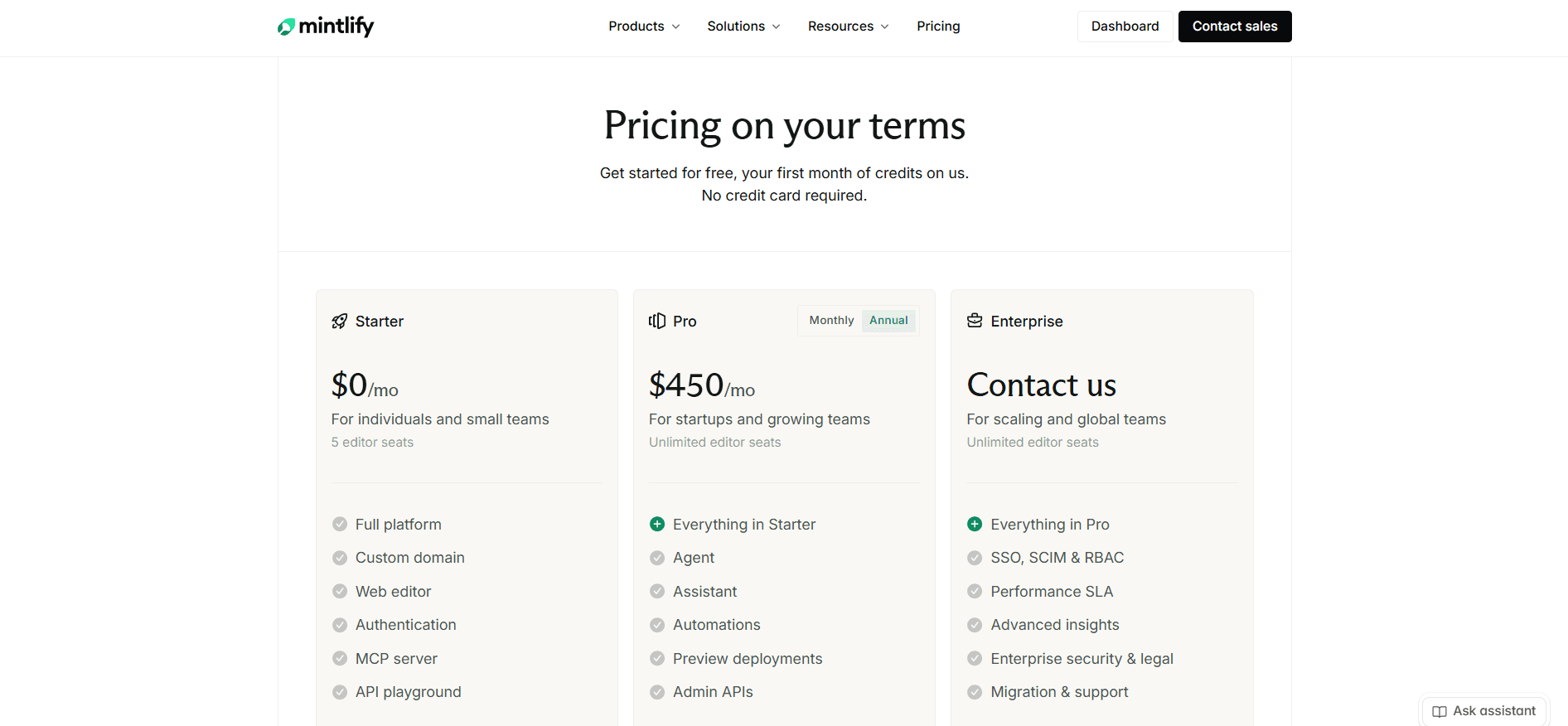
Starter is free with no time limit: five editor seats, a custom domain, the browser editor, the API playground, an MCP server, and the full machine-readable layer. No AI, beyond a 14-day trial carrying a one-time 5,000 credits [1].
Pro is $450 per site per month with unlimited editor seats and 10,000 credits, pooled across your organization so a second Pro deployment brings another 10,000 [1] [3]. The product is really sold on this plan, because it holds the assistant, the agent, automations, analytics, password protection, and preview deployments.
Enterprise is custom: SSO, SCIM, role-based access control, audit logs, PDF export, white labeling, self-hosting, EU hosting, the integration trigger for automations, the 21 external integrations, and migration services [1] [2]. Until you reach it, every editor on Pro can publish straight to production.
Credits top up at $145 for 15,000, $370 for 40,000, or $800 for 90,000, each cheaper per credit than the $0.01 overage rate. Overage ships off by default with a spending cap and alerts, and half of anything unused rolls over, capped at 1.5 times your monthly balance [1] [3]. Our Mintlify pricing breakdown works through the credit math in full.
Redocly
There is no free plan. There is a 30-day trial with full access and no credit card, after which you subscribe or export your data [4].
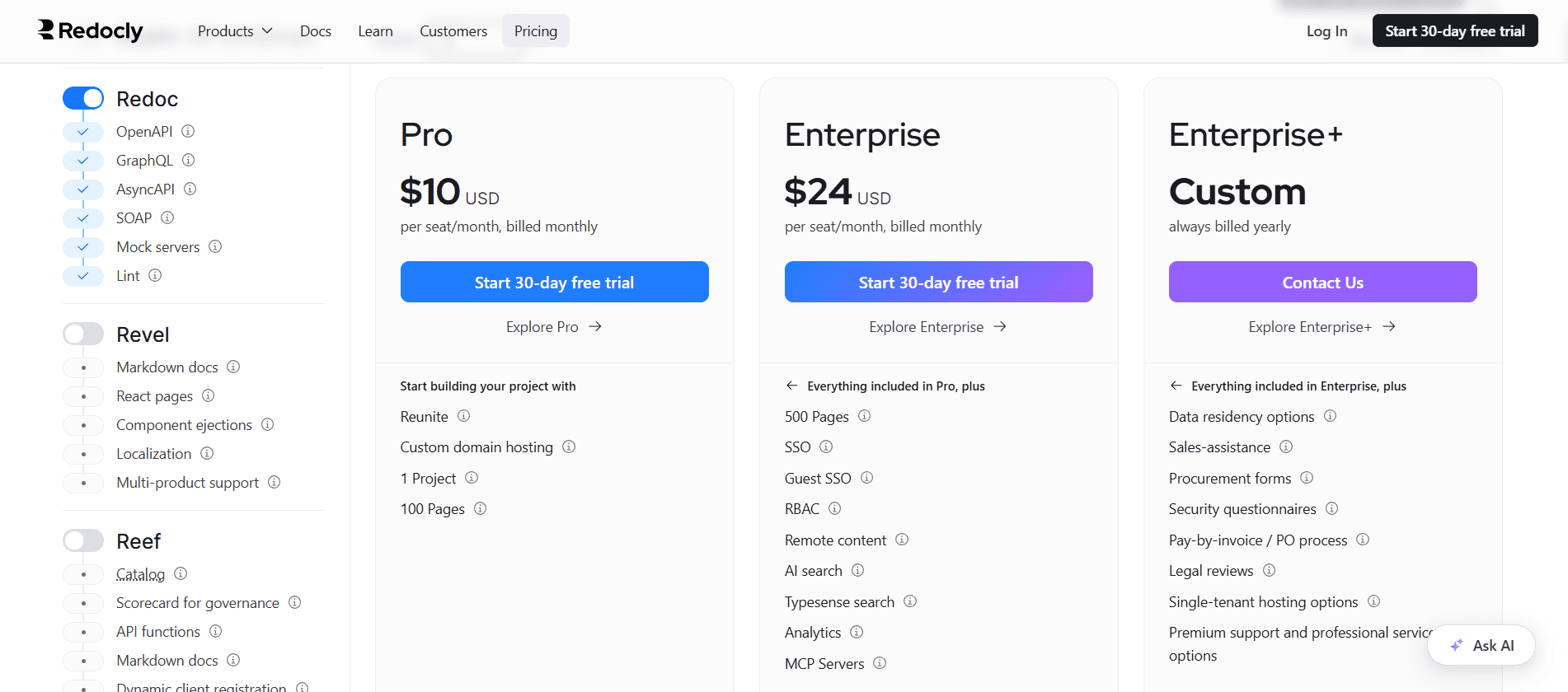
The seat rate is multiplied by how many of three modules you enable. Redoc is the API reference, Revel adds Markdown documentation and React pages, and Reef is the internal API catalog, with all three sold together as Realm. Reunite, the workspace and editor, is included everywhere [4].
Pro costs $9, $18, or $25 a seat a month for one module, two modules, or Realm. Enterprise costs $22, $44, or $59 on the same ladder and stays self-serve at a published price rather than a sales call, which is unusual in this category. Enterprise+ is custom. Billed monthly instead of annually, the same ladder runs $10, $20, and $28 on Pro and $24, $48, and $66 on Enterprise, and Enterprise seats step down through graduated volume tiers at very large headcounts [4].
Few teams pay the one-module rate. An API reference and Markdown documentation together take two modules at minimum, and the reader assistant takes Enterprise.
Underneath the seats sit three hard limits. Pages are the only metered item, at 100 on Pro and 500 on Enterprise with extras at a flat $0.12 a page a month. Projects and seats are bought in advance instead, one project included on every tier including Enterprise+, with extras at $49 a month [4].
None of the three bills you quietly, and each fails differently [5]:
- Out of pages: no further deployments until you cut pages or raise the budget.
- Out of projects: you cannot create another one.
- Out of seats: you cannot invite anyone, and on SSO with just-in-time signup a new user cannot log in at all.
Contributors consume seats alongside staff. Owner, Member, and Committer roles each take one, so an engineer fixing a typo under their own Git identity is billable, while Billing and Viewer roles cost nothing and readers are never counted [5]. Our Redocly pricing guide works through the modules, the meter, and the volume tiers.
Price from the pricing page, not the marketing pages. Redocly's own site contradicts itself in places: its product pages claim two projects and analytics on the entry tier where the pricing page, the calculator, and the billing FAQ all say one project and Enterprise analytics, and the calculator describes page prices as tiering down with volume when the published rate stays flat. Redocly also still hosts a pricing page for Workflows, the product Reunite replaced, carrying legacy plan names and figures. Get the modules and both meters confirmed in writing [4] [5].
What the Same Requirements Cost
Headline numbers settle nothing when one platform bills per site and the other per seat, so price a team instead. Take eight people who touch the documentation, one site, and roughly 370 routes, meaning about 250 Markdown pages plus a 120-operation API reference. The cheaper option in each row is in bold.
| What you need | Mintlify | Redocly |
|---|---|---|
| A plan you can evaluate on indefinitely | Free, five seats, no AI | None, a 30-day trial |
| Eight editors, Markdown pages and an API reference, no AI | $450/mo, Pro | $200/mo, eight Realm seats on Pro |
| That site at about 370 routes | $450/mo, pages are not metered | $232/mo, after $32 of page overage |
| Add a reader assistant | $450/mo, 400 answers a month | $472/mo, eight Realm seats on Enterprise |
| Add analytics, an MCP server, and role-based permissions | $450/mo plus a quoted Enterprise contract for the permissions | $472/mo, all three at the published Enterprise seat rate |
| 3,500 reader answers a month | $1,250/mo, Pro plus the 90,000-credit pack | $472/mo, at the cap, with no route past it |
| A second documentation site | $900/mo, a second subscription that also doubles your credits | $521/mo, a second project at $49 |
| Eighteen editors instead of eight | $450/mo, seats are unlimited | $1,062/mo, 18 Realm seats on Enterprise |
| Reader login and audit trails | Enterprise, quoted | $472/mo, published |
Verdict: Redocly passes Mintlify at the eighth seat. With the reader assistant in scope, Realm on Enterprise costs less than Mintlify Pro up to seven contributors and more from eight. Drop the catalog and buy two modules instead, and the crossover moves out to 11 seats. Count everyone who will hold a Committer role before you price either platform, because that number decides this more than any feature does. Redocly takes volume and governance: its assistant allowance comes with the seat and runs nearly nine times larger, while reader login, audit trails, and role-based permissions carry a published rate where Mintlify sends you to sales. Mintlify takes people and pages: unlimited seats make headcount growth free, and nothing counts by route, so a large API or a deep content library adds nothing.
Priced both and still not sure?
Documentation.AI bundles four documentation projects into one plan with unlimited editor seats, no page counting, and no overage billing on any tier, with the reader assistant and the documentation agent on the free plan rather than the top one.
Start free or book a demo and bring your existing docs across.
Public Documentation Experience
Both publish fast, responsive, accessible sites with light and dark modes, working search, and clean SEO output. They diverge on what the site is primarily for. Mintlify spends its effort on how the page looks and how quickly a writer can change it. Redocly spends its on the reference, and on the tooling either side of it.
Mintlify
Mintlify's default output needs the least work to look finished: clean typography, working dark mode, sensible syntax highlighting, and components for tabs, callouts, cards, steps, and code groups already built.
The playground generates from OpenAPI 3.0 or 3.1, or AsyncAPI 3.0 for WebSocket channels, and regenerates whenever your description changes. Authentication fields come from securitySchemes, an extension can prefill test credentials so a reader's first request succeeds, and code samples generate in 18 languages [2].
Customization stays unusually open for a hosted platform, with custom CSS and JavaScript on every plan including the free one and only white labeling reserved for Enterprise [1] [2]. Nothing counts pages, so site size never becomes a line item.
Access control stops at page level, so you cannot restrict one block inside an otherwise public page, and both preview deployments and password protection wait for the paid plan [1] [2].
Redocly
Redoc built this company, and the reference shows it. It renders OpenAPI, GraphQL, AsyncAPI, and SOAP, ships a mock server for endpoints that do not exist yet, and pairs with Redocly CLI for linting and an open source generator that emits typed clients in TypeScript, Python, Go, and PHP. Revel adds React pages, localization, and component ejection that lets you take Redocly's own components and rewrite them [5].
Search is where the tiering starts. The default engine carries a single facet. Typesense, which adds full facets, a filter panel, and keyword curation, requires Enterprise, and so does the assistant that would otherwise sit beside it [4] [5].
Pages are the constraint most teams meet first, and whether the ceiling bites comes down to how they are counted. Every route is a page, and Redocly builds an API reference as a metadata page plus one page per operation, so a 120-operation API eats more than the whole entry allowance before you write any prose. Reach the ceiling and deployments stop until you cut pages or raise the budget. Webview keeps the running count on screen while you work [4] [5].
Verdict: Redocly takes the reference, and Mintlify does not attempt the specification breadth, the mock servers, the generated client libraries, or the ejectable React components. Past the reference it reverses, because Redocly reserves faceted search and the on-page assistant for Enterprise and turns your documentation's size into a monthly decision, while Mintlify counts nothing and lets you restyle the result on any plan. Mostly generated reference with a little prose favours Redocly. Mostly guides and concepts with a reference attached favours Mintlify, and favours it more with every page you add. If the honest answer is both, Documentation.AI carries the reader assistant and custom CSS on every plan and never counts a page, so the content mix stops being a pricing decision.
Pros and Cons
Anything both platforms do competently has been left out. What remains is the material that tends to settle an argument one way or the other.
Mintlify
Pros
- Output that looks designed with no configuration, plus custom CSS and JavaScript on every plan when you want to change it [1] [2]
- Visual and source modes over the same MDX, with live cursors, comments, and drag-and-drop navigation [2]
- Unlimited editor seats on the paid plan, so a growing team is not billed for growing [1]
- No page limits, so a large API reference or content library costs nothing extra [1]
- A maintained local loop: CLI, preview server, MDX formatting, build errors, broken-link detection [2]
- Automations on four triggers, so a merge can repair the page it invalidated [2]
- Published credit rates, packs, rollover, and overage off by default, so the AI bill is forecastable [1] [3]
Cons
- No AI on the free plan past the 14-day trial, so the capability it is sold on cannot be lived with before paying [1]
- Nothing between free and the paid tier, a steep first step for a team of six [1]
- The allowance covers 400 reader answers, so traffic you do not control becomes a monthly capacity question [1] [3]
- Billed per site, so a second documentation product means a second subscription [1]
- Role-based access control, audit logs, SSO, SCIM, PDF export, white labeling, and self-hosting are all Enterprise, and without the first every paid-plan editor can publish live [2]
- GitLab setup means issuing an access token and building the webhook by hand [2]
- OpenAPI 3.0 and 3.1 plus AsyncAPI 3.0 only, with no GraphQL, gRPC, or SOAP [2]
Redocly
Pros
- The deepest API tooling of the two: OpenAPI, GraphQL, AsyncAPI, and SOAP, with mock servers, linting, and a CLI many teams already run in CI [5]
- Git provider coverage that includes Bitbucket Cloud, Azure DevOps, and self-hosted [5]
- Reviewer, a pull request agent that reads the specification and the prose together and catches what a linter cannot [5]
- Reef, an internal API catalog with governance scorecards, which most documentation platforms skip [4]
- A reader assistant allowance nearly nine times Mintlify's, included in the seat price rather than metered [4]
- An Enterprise tier with a published, self-serve price, so governance does not require a sales call [4]
- A published uptime and response SLA that applies to self-serve plans, not only negotiated contracts [5]
Cons
- No free plan of any kind, and the 30-day trial unlocks Enterprise, so it is easy to evaluate one product and buy another [4]
- The entry tier is thinner than it looks: the assistant, analytics, MCP server, role-based access control, SSO, and faceted search are all Enterprise, and one project is included even at the top [4]
- Pages are counted by route, so a mid-sized API description consumes the allowance alone, and hitting the limit stops deployments [4] [5]
- Contributors consume seats, and running out blocks invitations and SSO logins [5]
- No visual authoring at any price, so anyone outside engineering learns Markdown, branches, and pull requests before their first page [5]
- Every authoring AI needs Redocly's permission, since Writer, Scaffold with AI, and the embeddable assistant are early access, off by default, and priced nowhere [5]
- Marketing pages, the pricing calculator, and a retired product's pricing page contradict the current pricing page in several places [4]
Head to Head Comparison: Mintlify vs Redocly
| Category | Mintlify | Redocly |
|---|---|---|
| Best suited to | Documentation owned by a mixed team, with guides as well as reference | An API program where the specification drives everything |
| Free plan | Free forever, five seats, no AI | None, 30-day trial |
| Paid entry | $450 per site a month | $9 to $25 a seat a month, by module |
| Where the full product sits | Pro, published | Enterprise, published at $22 to $59 a seat |
| Editor seats | Five free, unlimited on Pro | Every contributor is billable, readers are free |
| Page limits | None | 100 on Pro, 500 on Enterprise, each API operation counts |
| Hitting a limit | The assistant pauses or bills, docs stay published | Deployments, invitations, or SSO logins stop |
| Visual editing | Visual and source modes in the browser | None, Markdown with a Markdoc toolbar |
| Publishing a change | Commit written for you, pull request optional | Branch, commit, pull request, merge |
| Restructuring | Drag and drop, or the agent | Manual file moves, config edits, hand-written redirects |
| Git providers | GitHub and GitLab, GitLab configured by hand | GitHub, GitLab, Bitbucket Cloud, Azure DevOps, self-hosted |
| Specification support | OpenAPI 3.0 and 3.1, AsyncAPI 3.0 | OpenAPI, GraphQL, AsyncAPI, SOAP |
| Mock server and API catalog | Not offered | Mock server, Reef catalog, Respect monitoring |
| Generated client libraries | Code samples in 18 languages | Typed clients in four languages, open source generator |
| Reader assistant | Pro | Enterprise |
| Answers included | 400 a month, packs and overage published | 3,500 a month per organization, no route past it |
| Authoring AI | Agent and automations on Pro | Early access, enabled by Redocly, unpriced |
| AI pull request review | Not offered | Reviewer, early access |
| Analytics, MCP, faceted search | Analytics on Pro, the other two on every plan | All three Enterprise |
| Custom CSS and JavaScript | Every plan, including free | Supported, with React pages and component ejection on Revel |
| Vendor branding in the footer | White labeling on Enterprise | Removable |
| Reader authentication | Password on Pro, OAuth and JWT on Enterprise | Access control on Enterprise |
| Role-based access and audit logs | Enterprise, quoted | Enterprise, published seat price |
| Published SLA | Enterprise | Published, applies to self-serve plans |
Mintlify takes the rows about who can contribute, how large the site can grow, and how much of the product one plan turns on. Redocly takes the rows about specification breadth, Git coverage, pull request review, and the tooling on either side of the documentation site.
Final Take
Two questions decide this: who is allowed to publish, and how many of them there are.
Pick Redocly if the specification is the product. Nothing in Mintlify replaces four specification formats across five Git providers, a mock server, a linter your CI already runs, an API catalog with scorecards, or a reviewer that catches a breaking change before a human reads the pull request. For a small engineering team it costs less, and its Enterprise tier is published rather than quoted, which shortens the governance conversation. Go in knowing the shape of the bill: every contributor is a seat, every API operation is a page, and the assistant, the analytics, and the MCP server all wait at Enterprise while the agent products wait for Redocly to switch them on.
Pick Mintlify if the documentation is the product. One plan carries the assistant, the agent, automations, analytics, and previews, seats are unlimited so headcount is free, pages are never counted so size is free, and a support lead can publish without opening a terminal. The costs are just as plain: nothing sits between the free plan and the paid one, the free plan has no AI to live with, a second site is a second subscription, and the governance Redocly publishes a seat price for is a sales call here.
What they share is the part worth arguing with. Both put the capability you are shopping for behind the tier above the one you were quoting, and both meter something a growing documentation site will eventually exceed. Mintlify meters reader answers and Redocly meters pages, and a successful site produces more of both every quarter. Neither closes the maintenance loop either: Mintlify runs its agent when code changes, which is the right trigger, and Redocly reads the pull request before a human does, which is the right checkpoint, but neither carries a reader's failed question back to the page that failed them. Before committing to either, it is worth pricing Mintlify alternatives and Redocly alternatives against the same requirements. If Mintlify is the fixed point on your shortlist, the same test runs through GitBook vs Mintlify, Mintlify vs ReadMe, Archbee vs Mintlify, Mintlify vs Fern, and Document360 vs Mintlify, or Mintlify vs GitBook vs ReadMe for three platforms at once.
That awkward middle is where Documentation.AI is aimed. The reader assistant and the documentation agent are on the free plan rather than behind the top tier, a reader question costs 10 credits rather than 25, pages are never counted, four projects come bundled into one plan with unlimited editor seats, and no plan bills an overage, so when credits run out the AI pauses and your documentation stays published. Its workflows run on the merge that changed the product and its assistant scores its own answers, so the questions your documentation failed come back as a list of pages you are missing. Both platforms here keep pages as Markdown in Git, so importing from either is a file move rather than a rewrite.
Migrating from Mintlify or Redocly?
Content moves as files, since both platforms keep pages in Markdown in Git and OpenAPI descriptions import directly. The work is rebuilding navigation and preserving your existing URLs, and our team will walk through it with you, redirects included.
Start free, book a demo, or ask us directly in the Documentation.AI Slack channel.
FAQs: Mintlify vs Redocly
1. Which Is Cheaper, Mintlify or Redocly?
It depends almost entirely on how many people hold an editor seat. Redocly bills per seat and per module, so eight contributors on Realm cost $200 a month on Pro or $472 on Enterprise at annual rates, while Mintlify charges $450 per site a month with unlimited seats. With a reader assistant in scope, Redocly is cheaper up to seven seats and Mintlify from eight. Above that the gap widens with every contributor, and it reverses again if you publish a second documentation site, which costs $49 a month on Redocly and a second subscription on Mintlify [1] [4].
2. Does Redocly Have a Free Plan?
No. Redocly offers a 30-day trial with full access to every feature and no credit card, after which you subscribe or export your data. Plan around one detail: the trial includes Enterprise features such as the reader assistant, analytics, and MCP servers that an entry-plan subscription does not carry, so it is easy to evaluate one product and buy another. Mintlify's free Starter plan has no time limit and includes five editor seats, a custom domain, the API playground, and an MCP server, but no AI beyond a 14-day trial grant [1] [4].
3. Can Non-Technical People Write Documentation on Each Platform?
On Mintlify, yes. The browser editor has a visual mode with drag-and-drop navigation, and it writes the branch, the commit, and the pull request on the writer's behalf. On Redocly it is a real change of habit. There is no block or visual editor at any price. Everything is Markdown in the Reunite editor with a formatting toolbar and Markdoc tag inserts, and every change goes through a branch, a commit, and a pull request that someone merges [2] [5].
4. Does Redocly Limit How Many Pages You Can Publish?
Yes, and the counting rule matters more than the number. The entry plan includes 100 pages and Enterprise 500, with extras at a flat $0.12 a page a month. Each route counts as a page, and Redocly builds an API reference as a metadata page plus one page per operation, so a 120-operation API clears the entry allowance before any prose exists. At the limit, deployments stop until you cut pages or raise the budget. Mintlify does not count pages at all [1] [4] [5].
5. How Many Reader Questions Does Each Platform Include?
Mintlify's paid plan includes 10,000 credits a month and an assistant answer costs a fixed 25, which is 400 answers, or about $1.13 each, with packs at $145, $370, and $800, and optional overage at $0.01 a credit. Redocly's assistant is Enterprise only and includes 3,500 questions a month for the whole organization, with no published way to buy more, after which readers get plain search results. Redocly includes far more and caps hard, Mintlify includes less and lets you buy past it [1] [3] [4].
6. Does Mintlify or Redocly Have Better AI?
They solved different halves. Mintlify's AI writes and maintains, through an agent that opens pull requests and automations that fire on merged code. Redocly's verifies: Reviewer comments line by line on every pull request, checking specifications for breaking changes and prose against the specification it cites, and its MCP and agent-readiness work goes further than Mintlify's. Access separates them in practice. Mintlify puts its AI on one published plan, while Redocly's assistant requires Enterprise and its agent products are early access, off by default, enabled per organization, and priced nowhere [2] [4] [5].
7. Which Handles Non-REST APIs Better?
Redocly, on specification breadth. It renders OpenAPI, GraphQL, AsyncAPI, and SOAP, ships a mock server for endpoints that are not live yet, and pairs with an open source generator that produces typed clients in TypeScript, Python, Go, and PHP. Mintlify covers OpenAPI 3.0 and 3.1 plus AsyncAPI 3.0 for WebSocket channels, and generates copyable code samples in 18 languages rather than installable libraries. If your API surface includes GraphQL or gRPC, the shortlist narrows quickly [2] [5].
8. How Hard Is It to Move Off Either Platform?
Easier than most teams expect, because both keep pages as Markdown in a Git repository you already control and both import OpenAPI descriptions directly, so the content transfers without rewriting. The work is in the navigation, which each platform describes in its own configuration file, and in preserving your existing URLs so inbound links and rankings survive. Leaving Redocly adds one more job: Markdoc tags and ejected React components have no equivalent elsewhere and get rewritten by hand [2] [5].
Sources
- Mintlify. "Pricing." Mintlify. https://www.mintlify.com/pricing
- Mintlify. "Mintlify Docs." Mintlify. https://www.mintlify.com/docs
- Mintlify. "Simpler, Outcome-Based AI Pricing." Mintlify Blog. https://www.mintlify.com/blog/outcome-based-ai-pricing
- Redocly. "Pricing." Redocly. https://redocly.com/pricing
- Redocly. "Redocly Docs." Redocly. https://redocly.com/docs
Gated or metered?
No page caps, no AI tier
The reader assistant, the docs agent, and analytics arrive on the free plan instead of the top one.
Start freeNo credit card required