Comparisons · · 25 min read
5 Best Redocly Alternatives in 2026
Redocly multiplies a per-seat rate by the number of product modules you switch on, holds the reader assistant and analytics for Enterprise, and asks every contributor to open a pull request. This guide compares the five alternatives teams actually shortlist, with published prices, real plan boundaries, and what each one costs a growing team.

Roop Reddy
Co-Founder, Documentation.AI
On this page
Most teams meet Redocly through Redoc, the open-source renderer that turns an OpenAPI file into a readable reference. The commercial platform is built on that renderer and on one idea: documentation is code, so it lives in Git and moves through pull requests.
That idea is also what sends teams looking. Redocly's price is a per-seat rate multiplied by the number of product modules you turn on, there is no free plan, and the two things most 2026 buyers shortlist on, a reader assistant and page analytics, both sit on Enterprise. Every correction to a published page goes through a branch, a pull request, and a review.
This guide ranks five alternatives in the order most teams should evaluate them, then compares them feature by feature, prices the same team on each one, and covers the free and open-source routes. Every price below is what the vendor publishes, with annual rates shown where they differ from monthly.
Quick Verdict (TL;DR)
Documentation.AI is the best Redocly alternative for most teams in 2026. It publishes one price per plan rather than a rate you multiply by modules, puts the reader assistant and AI answer analytics on every tier including the free one, and gives writers a visual editor over the same MDX your engineers keep in Git. Standard is $55 a month and Pro is $159.
The other four each win a narrower job:
- Documentation.AI: best overall, and the pick when the AI assistant and analytics need to reach readers without an Enterprise contract
- Mintlify: the closest like-for-like docs-as-code swap, and the one that needs least design work to look finished
- Scalar: best open-source-first option, and the only alternative here that also generates SDKs
- Stoplight: best for teams whose real problem is API design and governance rather than publishing
- ReadMe: best for a developer portal where per-key usage data decides the purchase
Why Look for Alternatives to Redocly?
Redocly is a strong product with an unusually specific shape. It is built for engineering organizations that already run everything through Git and want their API documentation governed the same way. If that is your team, the reasons to leave are mostly about price structure. If it is not, the reasons are about who can contribute at all.
What Redocly Does Well
Redoc is one of the best OpenAPI renderers available, and it is free. The open-source project is widely deployed, and the commercial platform inherits its rendering directly. If your evaluation comes down to "does the API reference look right", Redocly tends to score well.
The Git workflow is a real Git workflow, not a metaphor. Branches, pull requests, status checks, and preview deployments behave the way engineers expect, because they are the same mechanisms. Redocly checks and your own repository checks both run before a merge, and the preview link is per branch.
Linting and governance come built in. Redocly CLI enforces style guides against your OpenAPI descriptions, and the Reef module adds an API catalog with scorecards. Nothing else in this comparison treats API quality as a first-class product surface.
The SLA starts at the entry plan. Redocly publishes 99.9 percent uptime and an average 24-hour support response in its standard subscription agreement rather than an Enterprise addendum, so it applies from Pro up. [1] Very few competitors commit to anything below Enterprise.
Where Redocly Falls Short
The price is a multiplication, not a number. Pro is $10 per seat a month for one module, $20 for two, and $28 for Realm, which is all three. Enterprise is $24, $48, and $66 on the same pattern. [1] Redoc renders your API description and nothing else, so the moment you want a getting-started guide next to it, you are adding Revel and doubling the seat rate. Our Redocly pricing guide works through every meter with real bills.
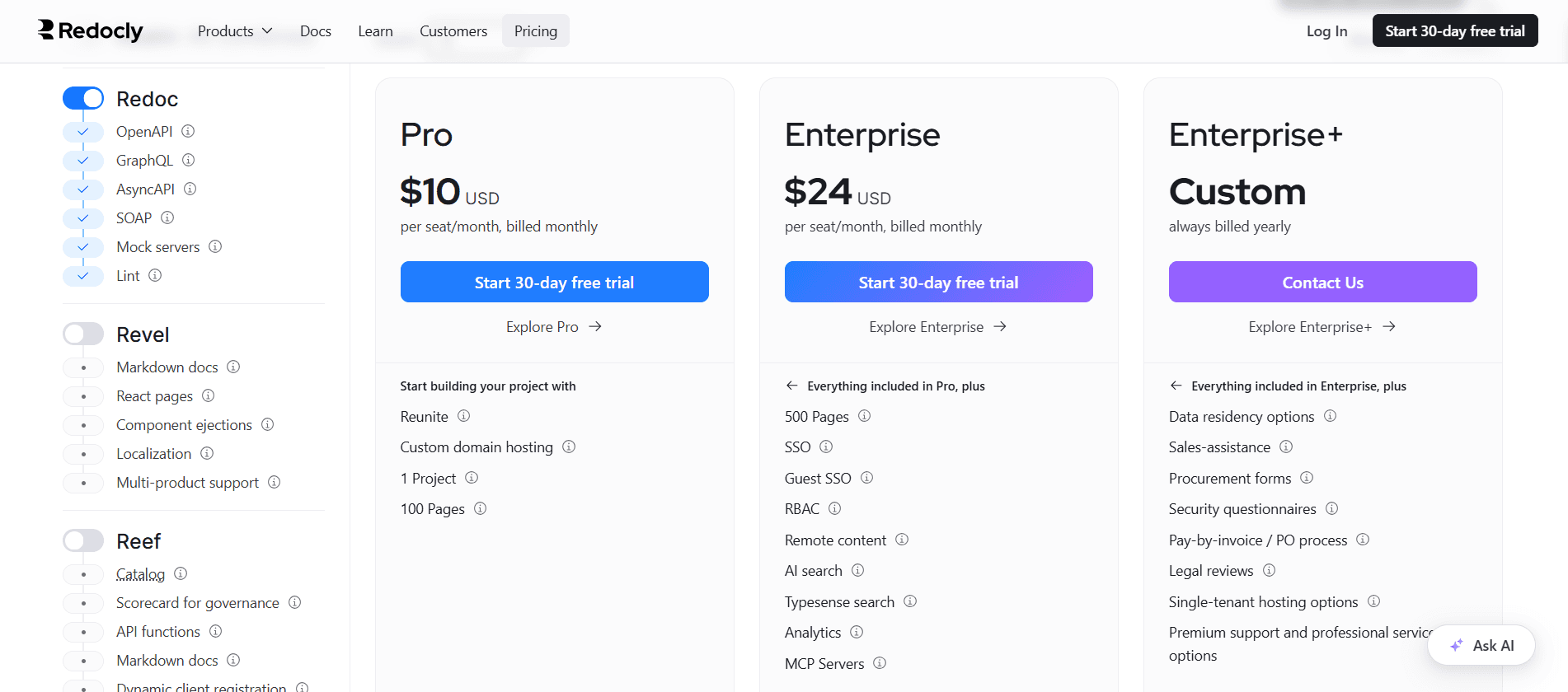
There is no free plan. Redocly offers a 30-day trial with no card, and after that every seat is billed. [1] Four of the five alternatives below have a free tier you can publish from.
The reader assistant is Enterprise-only and capped. The AI assistant is limited to Enterprise and Enterprise+, and it is capped at 3,500 questions a month per organization rather than per seat, with no published way to buy more. [1] Above the cap, readers get plain search results.
Analytics are Enterprise-only too. The reports are genuinely good, including a "most not found" view of search queries that tells you exactly which pages are missing. They also sit on Enterprise, so at $10 a seat you publish blind. [2]
Nothing in the editor writes. Redocly's own positioning is "AI writes, Redocly verifies", so there is no drafting assistant in the authoring experience. Redocly Agent has a Writer half, but Reviewer and Writer are both early access, off by default, enabled per organization, and priced nowhere. [2]
Non-technical contributors are effectively locked out. A product manager who spots a wrong sentence has to learn the file tree, edit the Markdown, commit to a branch, open a pull request, and wait. In practice they send it to an engineer instead, and the documentation ages at the speed of engineering attention.
The meters block builds rather than billing you. Any committer active in the last 30 days takes a paid seat. Every operation in your OpenAPI description counts as a page against 100 on Pro and 500 on Enterprise. One project is included on every tier, including Enterprise+, so a second documentation site is an extra line item at any price. [2]
The Redocly review scores the whole platform.
You can test this list before you price it. Start free carries five editors, the AI Assistant, and an API playground, your Markdown and your OpenAPI file import as they are, and your Redocly site keeps serving readers while you compare.
1. Documentation.AI
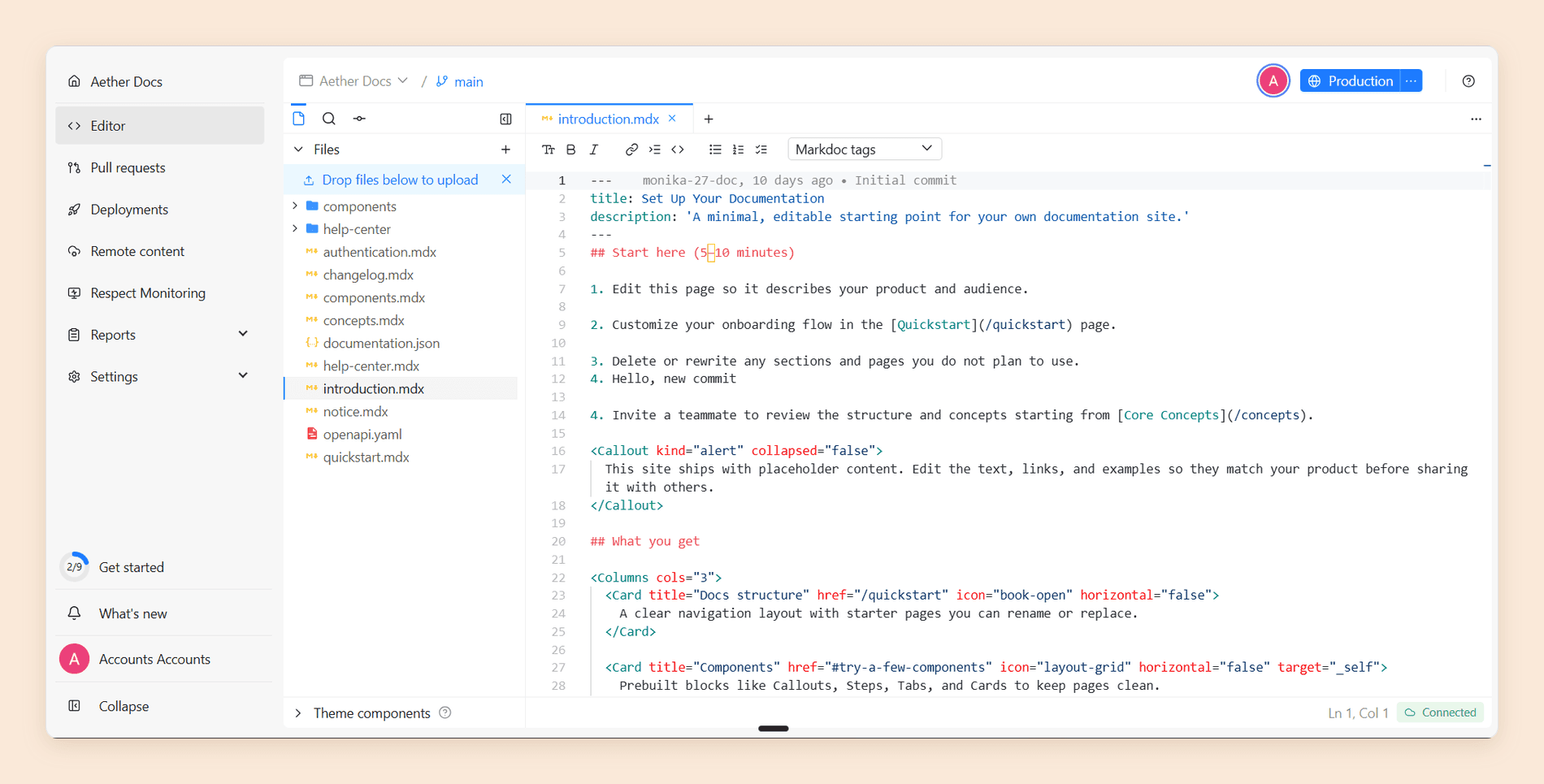
Documentation.AI answers Redocly's two hardest questions with a price list. Everything Redocly sells as a module or reserves for Enterprise sits on a plan you can read: Markdown pages and API reference in the same project, the reader assistant on the free tier, AI answer analytics on every tier, and unlimited editor seats at $159.
The editing model is the other half of the argument. Engineers work in MDX through two-way Git sync with GitHub or GitLab, writers work in a visual editor over the same files, and neither has to adopt the other's workflow. A correction does not require a pull request unless you want one.
Features
- Everything in one project, with no modules to add. Guides, API reference, and the playground ship together on one plan, where Redocly sells Redoc, Revel, and Reef separately and multiplies the seat rate by how many you switch on. [1]
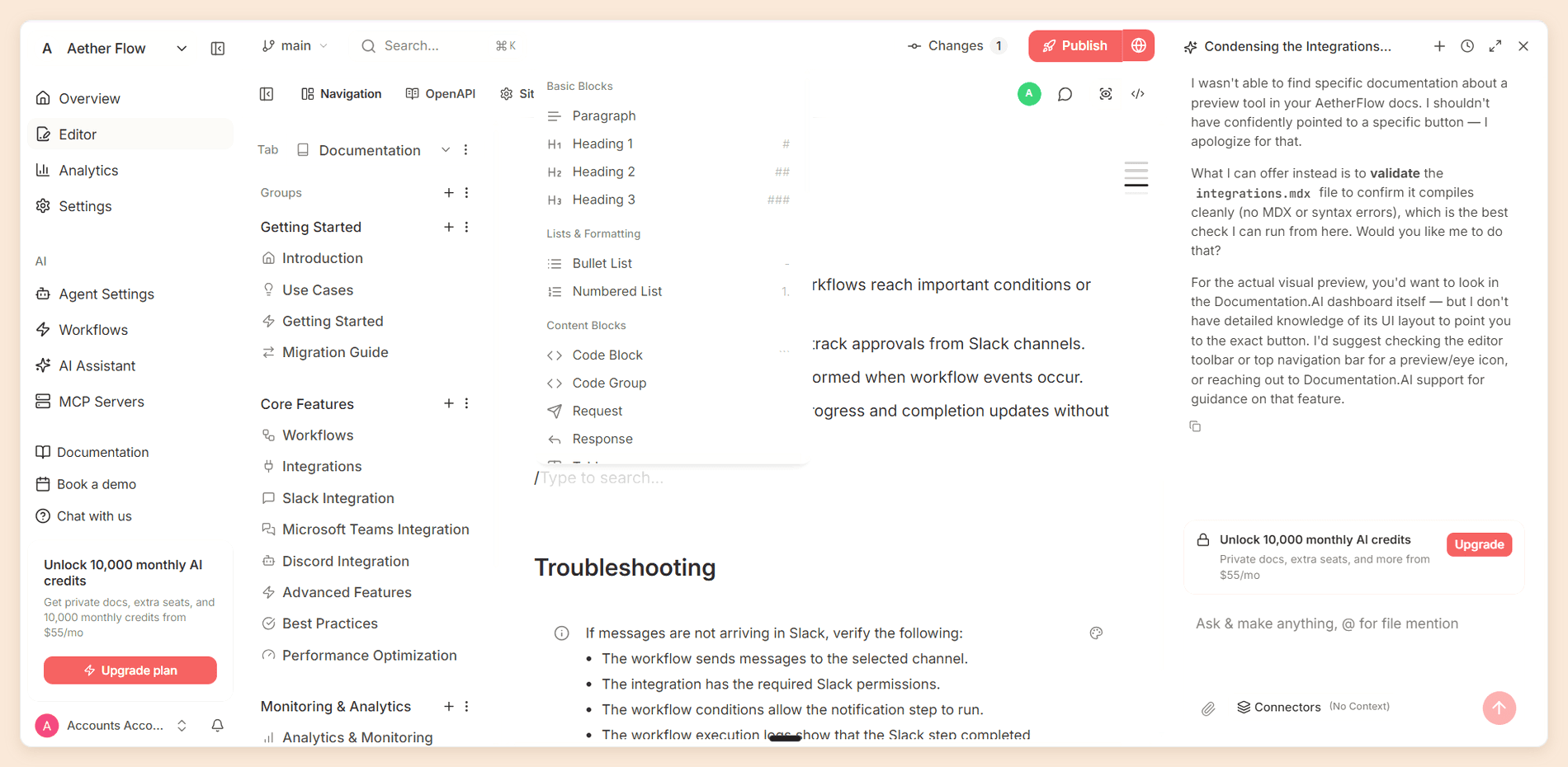
- AI Assistant with confidence scores. Answers readers with citations and scores each answer, so the low-confidence questions become a list of the pages your documentation is missing. It runs on the free plan, where Redocly's needs Enterprise and stops at 3,500 questions a month per organization. [1]
- Analytics on every plan. Standard search analytics and AI answer analytics are included from Starter up, where Redocly holds the equivalent for Enterprise. [3]
- Anyone can publish a fix. Writers and support correct a live page in the visual editor without opening a pull request, while engineers keep MDX in Git through two-way sync. Redocly routes every correction through a branch and a review.
- AI Documentation Agent. Drafts and edits pages, and restructures navigation while keeping existing URLs working, pulling context from GitHub, GitLab, Jira, and Confluence. Redocly's stated position is that AI writes and Redocly verifies, so its editor carries no drafting assistant at all. [2]
- Publishing for AI tools.
llms.txt, a reader MCP server, and an authoring MCP server that lets your team write docs from Cursor or Claude Code, all on every plan, where Redocly's docs MCP server is Enterprise. [1] - Access control with a published price. Password protection on Standard, private docs with JWT or OAuth login and role-based permissions on Pro, and SSO with SCIM on Enterprise.
Pricing
| Plan | Price | What it includes |
|---|---|---|
| Starter | Free | Five editor seats, one project, 10,000 one-time credits, AI Assistant and Agent |
| Standard | $55/mo | 10 seats, two projects, 10,000 credits a month, password protection, PDF export |
| Pro | $159/mo | Unlimited seats, four projects, 30,000 credits a month, JWT and OAuth login, role-based permissions, advanced analytics |
| Enterprise | Custom quote | SSO with SAML or OIDC, SCIM, custom SLAs, and branding removed from the footer |
A reader question costs 10 credits whatever the length of the answer, and an agent task costs between five and 320. Half of unused credits roll over, and there is no overage billing, so running out pauses the AI until the next cycle instead of adding to your invoice. The Documentation.AI pricing page lists every plan in full. [3]
Pros and Cons
Pros
- One price per plan instead of a seat rate multiplied by modules
- The assistant, the agent, and AI answer analytics all work on the free plan
- Unlimited editors and four projects on Pro, where Redocly includes one project on every tier
- Custom CSS and JavaScript on every plan, including the free one
- Writers publish without a pull request, and engineers keep their Git workflow
Cons
- No SDK generation, and no API catalog or scorecard equivalent to Redocly's Reef
- No local CLI, so previews build in the cloud rather than on your machine
- AI-drafted pages still need human judgement and a check before they publish
- Removing the footer branding requires Enterprise
Why Choose Documentation.AI Over Redocly
The module maths disappears. On Redocly, an API reference with guides beside it is two modules, which makes Pro $20 a seat and Enterprise $48. Ten editors on Enterprise with two modules is $440 a month billed annually. Documentation.AI puts guides, API reference, and the playground in the same project on one plan, so the same 10 people are $55 a month on Standard.
Reader AI reaches readers without a contract. Redocly's assistant needs Enterprise and stops at 3,500 questions a month across the whole organization. Documentation.AI charges 10 credits a question, includes 10,000 a month on Standard, and works on the free plan, so you can put it in front of real traffic during the evaluation rather than after the purchase order.
Analytics arrive before you need them. Knowing which questions your documentation fails to answer is most valuable in the first month, which is exactly when a Redocly customer on Pro cannot see it. AI answer analytics ship on every Documentation.AI plan, including Starter.
Everyone can fix a sentence. This is the change most teams feel fastest. Support and product edit in the browser and publish, engineers keep MDX in Git, and the sync runs both ways. Our Slack channel is the quickest place to sanity-check a move.
Verdict
Redocly makes you buy capability in pieces and gates the two pieces that matter most to a public documentation site. Documentation.AI is the most complete answer to that, and the gap widens the more people touch your docs. Choose it when documentation is owned by more than engineering, when the reader assistant has to earn its keep before an Enterprise conversation, or when you would rather size next year from a pricing page than a calculator. Keep Redocly if API governance is the product you are actually buying.
The Redocly vs Documentation.AI comparison runs both platforms through the same tests.
2. Mintlify
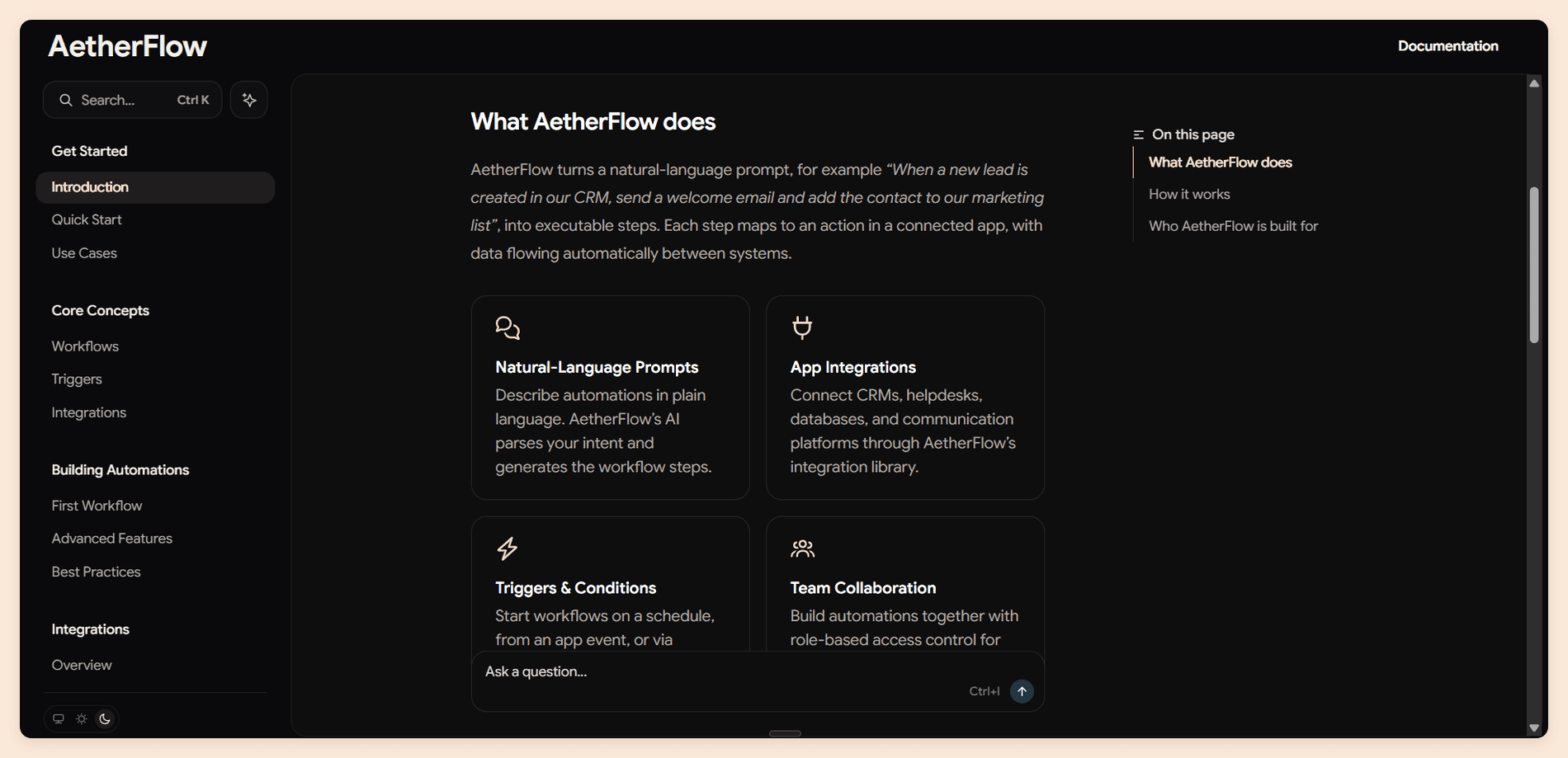
Mintlify is the closest like-for-like swap for Redocly's publishing half. Both keep content as MDX in a Git repository, both generate an API reference from your specification, and both expect engineers to be comfortable. The difference is what arrives configured.
Redocly customization means learning its theming system, its CSS variables, and its component ejection model. Mintlify's published design works out of the box, which is why teams who care about how the site looks and do not want a front-end project tend to land here. We wrote a full Mintlify review by building a sample documentation site on it and testing every part of the platform.
Features
- Published design. Typography, dark mode, and components for tabs, callouts, cards, and steps work without configuration, and custom CSS is accepted on every plan including the free one.
- API playground. Interactive pages from OpenAPI 3.0 or 3.1, or AsyncAPI 3.0 for WebSocket channels, with code samples in 18 languages and prefilled test credentials.
- A collaborative editor. Visual and source modes, live cursors, comments, suggestions, and drag-and-drop navigation, with pull requests syncing into editor branches.
- A real local toolchain. The
mintCLI runs a preview server and catches broken links before they ship. Redocly matches this with its own CLI, and most hosted platforms do not. - Assistant and agent. The assistant cites its sources, the agent opens pull requests rather than writing to the live site, and automations run it on content changes, code changes, or a schedule.
Pricing
| Plan | Price | What it includes |
|---|---|---|
| Starter | Free | Five editor seats, custom domain, web editor, API playground, no AI |
| Pro | $450/mo per deployment | Unlimited editor seats, the agent, the assistant, automations, preview deployments |
| Enterprise | Custom quote | SSO, SCIM, role-based permissions, advanced insights, performance SLA |
Since 8 September 2026 an answered reader question costs 25 credits and a documentation update from an automation costs 250, while the editor and Slack agents draw none. Pro includes 10,000 credits a month. [4] Our Mintlify pricing guide takes the credit model apart.
Pros and Cons
Pros
- Published design that needs almost no configuration, where Redocly theming is a skill
- Unlimited editor seats on Pro, so headcount never moves the bill
- Custom CSS on every plan, including the free one
- A local CLI with preview and broken-link checking
- One plan covers guides and API reference, with no module to add
Cons
- Nothing between a free plan with no AI at all and $450 a month
- Each additional documentation site is another Pro subscription
- Pro's credits cover roughly 400 answered reader questions a month
- Role-based permissions, audit logs, and SSO all need Enterprise
- No API catalog, scorecards, or governance tooling
Why Choose Mintlify Over Redocly
Choose Mintlify when your team is genuinely happy in a Git workflow and the thing Redocly costs you is design time. The seat model is the second reason: Pro is a flat $450 a month with unlimited editors, so a team of 25 pays the same as a team of 10, where Redocly bills every committer active in the last 30 days.
What runs the other way is the entry price and the governance story. Redocly Pro starts at $10 a seat, so a small team publishing one API reference pays far less there, and nothing in Mintlify replaces Redocly CLI linting or the Reef catalog. Our Mintlify alternatives guide covers where the $450 step starts to bite.
Verdict
Mintlify is the right Redocly alternative when the published site is the product and your contributors are all engineers anyway. It solves Redocly's design and module problems and inherits its cultural one, because MDX in a repository is still the model. If the reason you are leaving is that a writer cannot fix a typo, this swap does not fix it.
If the blocker is who can publish rather than how the site looks, book a demo and watch a writer correct a live page without opening a pull request, while your engineers keep the same MDX in the same repository.
3. Scalar
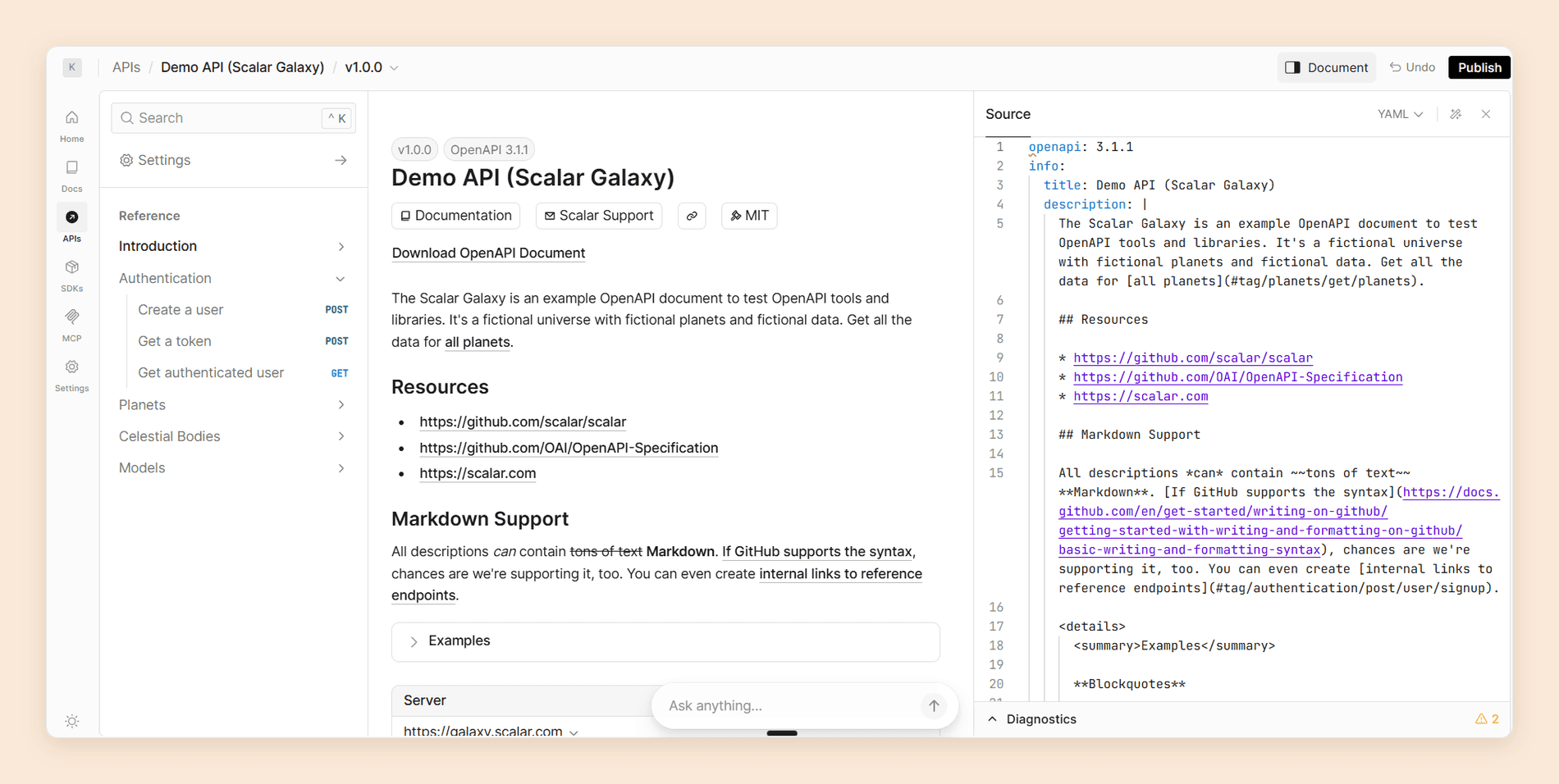
Scalar is the closest thing in this comparison to what Redoc was when it won the category: an open-source API reference renderer good enough that people adopt it without being sold to.
It is also the only alternative here that generates SDKs, which puts it on a different axis from the rest. Where Redocly sells you modules for rendering, Markdown, and cataloging, Scalar sells docs, SDKs, and MCP servers from the same OpenAPI document.
Features
- Open-source API reference and client. The renderer and the REST client are MIT licensed, run offline, and work on web, macOS, Linux, and Windows with no account.
- SDK generation. TypeScript, Python, Java, Go, C#, PHP, and more, with an automated GitHub workflow, publishing to language registries, and automatic sync with the docs.
- Hosted MCP servers. Available from Pro up, deployed to production rather than run locally, which is the piece Redocly reserves for Enterprise.
- Agent Scalar. A credit-metered agent covering docs chat and MCP tool calls, with the conversion published on the pricing page.
- Git Sync with Markdown and MDX from Pro, plus landing pages, themes, and custom HTML, CSS, and JavaScript.
Pricing
| Plan | Price | What it includes |
|---|---|---|
| Free | $0 | One editor seat, three APIs, one SDK up to 25 endpoints, 50 Agent credits |
| Pro | $150/mo, or $125/mo billed yearly | Five seats, 15 APIs, Git Sync, MDX, custom domains, hosted MCP, access groups, 500 credits |
| Business | $600/mo, or $500/mo billed yearly | 10 seats, 25 APIs, SSO and SAML, subpath hosting, 2,000 credits |
| Enterprise | Custom quote | Unlimited APIs, RBAC, priority support, SLAs, migration services |
| Additional SDKs | $150/mo each on Pro, $600/mo each on Business | One SDK is one language target for one API, with volume discounts |
One Agent Scalar credit covers 200 MCP tool calls, two docs chat messages, or 50,000 tokens, so Pro's 500 credits are about 1,000 answered reader questions. [5]
Pros and Cons
Pros
- A genuinely free tier you can publish from, where Redocly has none
- Open source under MIT, so the renderer and client survive any pricing change
- SDK generation from the same specification, which no other platform here offers
- Hosted MCP servers from Pro, against Enterprise on Redocly
- The API client is a credible Postman replacement at no cost
Cons
- Editor seats are fixed per plan at one, five, and 10, with no published per-seat add-on
- Each extra SDK is a full $150 or $600 a month, so multi-language support gets expensive fast
- RBAC is Enterprise only, the same boundary Redocly draws
- gRPC, GraphQL, SOAP, WebSocket, and SSE clients are all listed as coming soon
- No analytics tier published at all, so reporting is harder to compare than Redocly's
Why Choose Scalar Over Redocly
Both platforms start from an open-source renderer and both are specification-first, but Scalar publishes a free plan, includes Markdown and MDX inside Pro rather than as a paid module, and puts hosted MCP servers two tiers below where Redocly does.
The SDK line is the real differentiator. If part of what you want from your API documentation is client libraries your customers install, Redocly does not do it and Scalar does. That can collapse two vendors into one, provided you only need one or two language targets, because the third SDK costs more than the plan.
Verdict
Scalar is the pick when you liked Redoc more than you liked Redocly, and when your API program would benefit from SDKs alongside the reference. It is a younger product with thinner analytics and tighter seat counts, so a documentation team of eight will outgrow Pro on people before it outgrows it on features. Read the seat row before the price row.
Counting seats rather than features? Documentation.AI includes 10 editors on Standard and drops the cap entirely on Pro, with the assistant and analytics on both. The plans are listed in full.
4. Stoplight
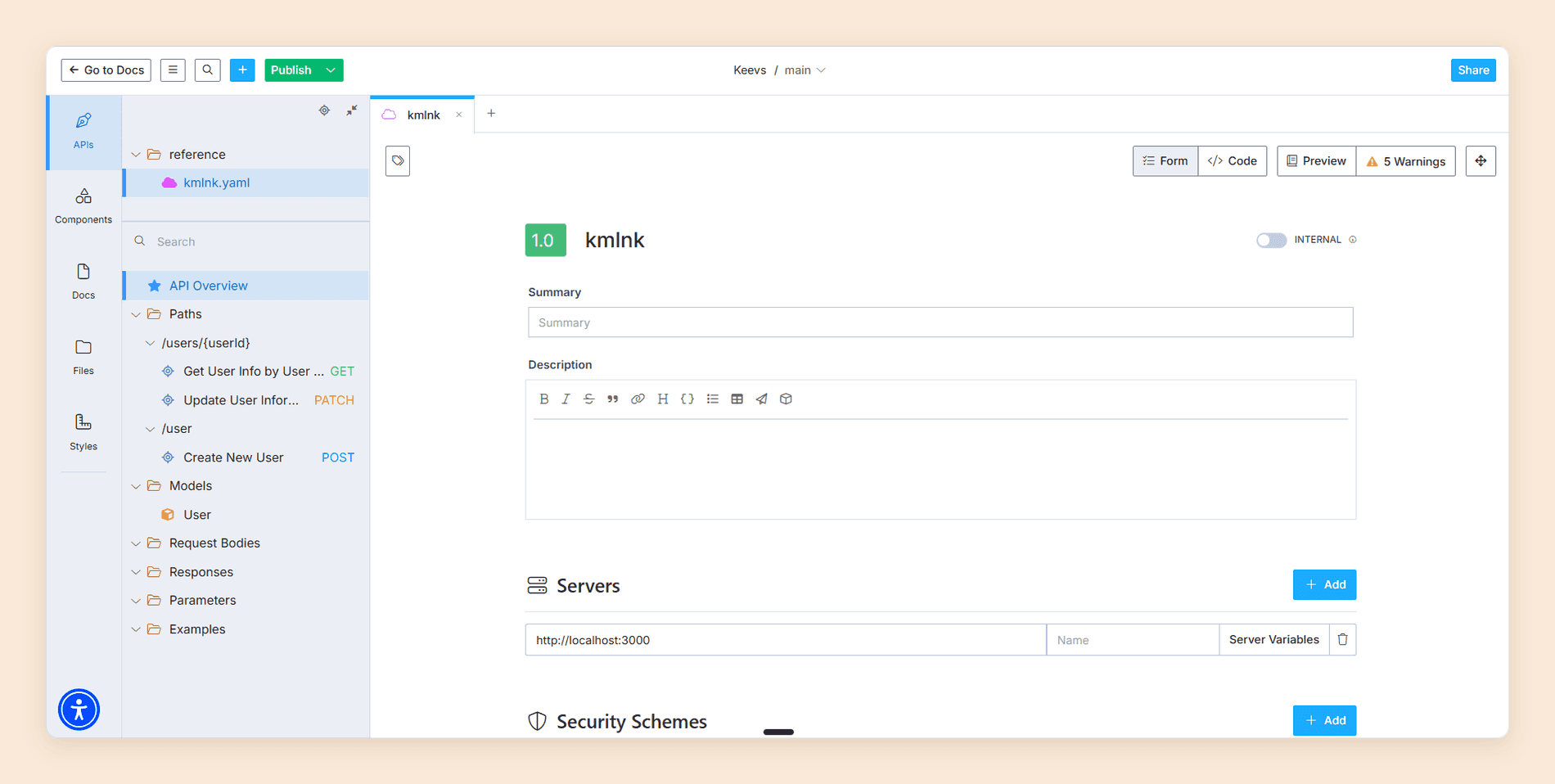
Stoplight is the alternative for teams who discover, partway through a Redocly evaluation, that publishing was never their real problem. It is built around designing APIs before they exist: a visual OpenAPI editor, mock servers from the specification, and Spectral linting to hold a style guide.
Its documentation output is competent rather than remarkable. What Stoplight actually competes with is the Redocly CLI and the Reef catalog, the governance half of Redocly's product, and it does that at a lower per-seat price than anything else here.
Features
- A visual OpenAPI and JSON Schema designer. Build and edit a specification in a form-based editor, with code-based editing available for anyone who prefers it. This is the strongest visual design surface in the comparison.
- Instant mock servers. Every API gets an automatic mock with request validation, configurable response codes, and static or dynamic responses, so clients can build before the backend exists.
- Style guides and governance. Shared style guides, workspace groups, and design validation across up to 20 teams on Pro Team, backed by Spectral, its open-source linter.
- Interactive documentation. Rich Markdown articles, an API console, code generation, versioning, theming, and custom domains, with branding removal on Pro Team.
- Open-source foundations. Spectral, Prism, and Elements are all open source and usable independently of the hosted platform.
Pricing
| Plan | Price | What it includes |
|---|---|---|
| Free | $0 | One user, one project, visual designer, mock servers, interactive docs |
| Basic | $44/mo billed annually, $56 monthly | Three users, unlimited projects, then $11 or $14 per extra user |
| Startup | $113/mo billed annually, $147 monthly | Eight users, private projects, multi-branch, custom domains, theming |
| Pro Team | $362/mo billed annually, $453 monthly | 15 users, up to 20 teams, shared style guides, SSO and LDAP, branding removal, then $22 or $27 per extra user |
| Enterprise | Custom quote | Unlimited projects and teams, invoicing, priority support |
Every paid plan includes a 14-day trial. [6]
Pros and Cons
Pros
- The best visual API designer here, and the only one non-developers can use to shape a specification
- Mock servers from the specification, which no other platform in this comparison offers
- SSO and LDAP at $362 a month rather than on an Enterprise quote
- Unlimited projects from Basic up, where Redocly includes one on every tier including Enterprise+
- Spectral and Prism are open source and keep working outside the subscription
Cons
- No AI features appear anywhere on the pricing page, so there is no reader assistant and no writing help
- Per-user charges apply above the included count on every plan
- The documentation experience is the weakest of the five for a content-heavy site
- Product communication has been quiet, so roadmap questions are worth asking before you commit
- No analytics beyond an integration hook
Why Choose Stoplight Over Redocly
Choose Stoplight when the specification is the artifact you are trying to improve. Redocly lints and catalogs APIs; Stoplight designs them, mocks them, and lints them, and it lets a product manager participate in that work through a visual editor rather than a YAML file. For an organization standardizing API design across many teams, that is a different and often more valuable job.
Price helps the argument. Pro Team at $362 a month covers 15 users with SSO, style guides, and 20 teams. Reaching comparable governance and access control on Redocly means Enterprise seats multiplied by Reef and Revel, and the bill passes Stoplight's well before 15 people.
Verdict
Stoplight is a specialist, and buying it as a Redocly replacement only works if you are honest about which half of Redocly you were using. Teams that need a polished, AI-assisted documentation site will find it thin, and should pair it with one of the publishing platforms above or look at Documentation.AI instead. Teams drowning in inconsistent APIs will get more from it than from anything else on this list.
5. ReadMe
ReadMe sells something none of the others do: a documentation site that knows which endpoints each individual customer called, and when they last got a 401. If your support team's most common question is "what is this specific integrator doing", ReadMe is the only real answer here.
It is also the furthest from Redocly culturally. Where Redocly assumes a repository, ReadMe assumes a hosted dashboard with Git sync bolted alongside it, and its recent Refactored rebuild changed enough that migration deserves its own conversation.
Features
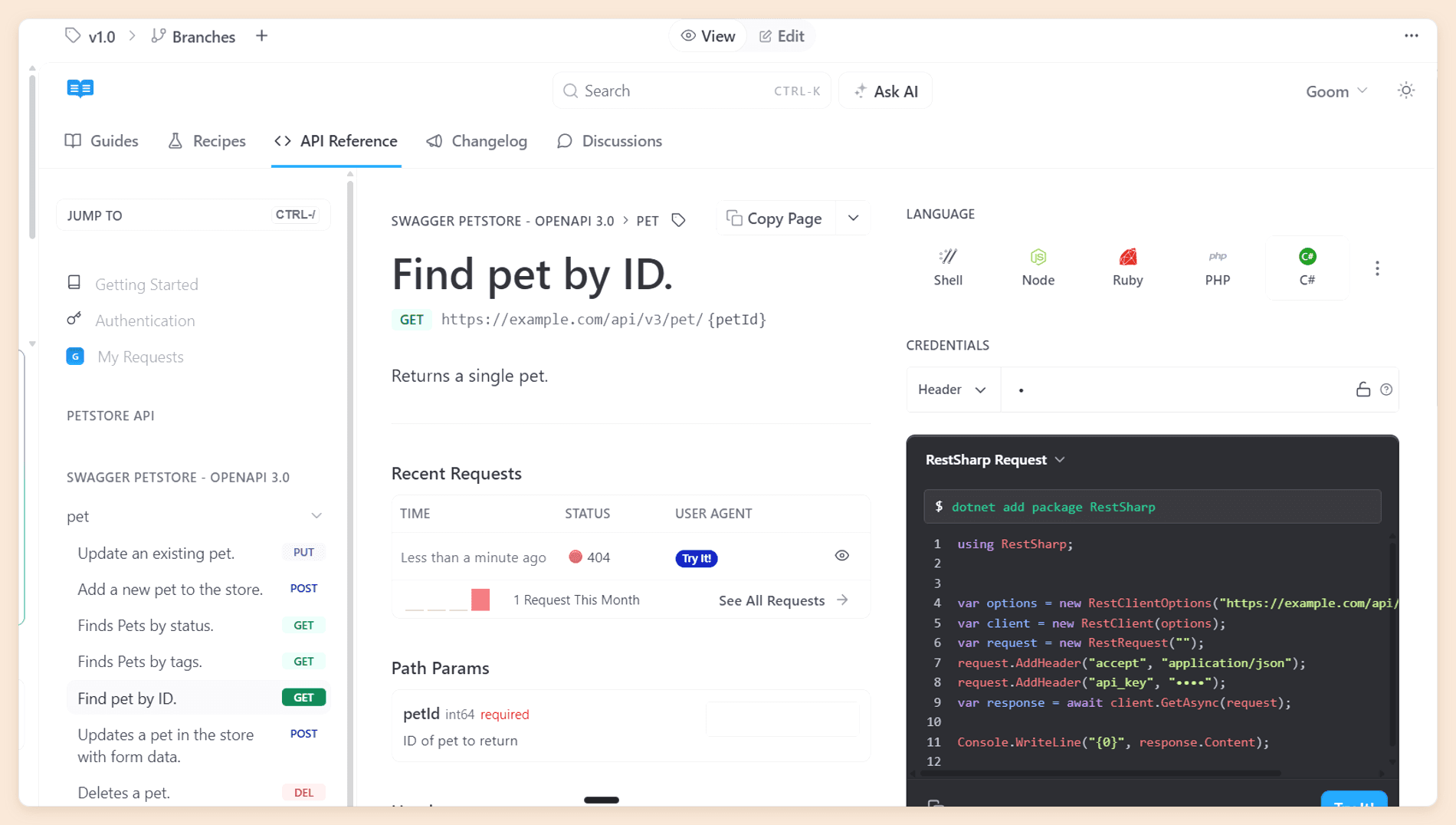
- Per-key API usage metrics. The Developer Dashboard ties API logs to individual users, so you can see real adoption rather than page views.
- An interactive API reference with language tabs, prefilled credentials, a Try It console, and a recent-requests log.
- Recipes and guides alongside the reference, with a visual editor that needs no Git knowledge.
- AI features by tier. LLMs.txt, an MCP server, and AI change summaries on the free plan, with Ask AI sold as an add-on and the AI Linter and GitHub AI Writer on Pro.
- Bi-directional Git sync for teams who want the repository to stay authoritative.
Pricing
| Plan | Price | What it includes |
|---|---|---|
| Starter | Free | One teammate, one project, one published version, custom domain, API reference |
| Pro | $250/mo billed annually | Five admins, then $20 each, one project, reusable content |
| Enterprise | Custom quote | Editor and Viewer roles, AI Translations, full Docs Audit, private AI context |
| Ask AI | $150/mo add-on | Reader-facing AI answers, purchasable on any tier |
| Developer Dashboard | $100/mo add-on | Five million logs, extended retention, then $10 per additional million |
Figures are from the ReadMe pricing page, September 2026, and our ReadMe pricing guide breaks down the add-on stack.
Pros and Cons
Pros
- Per-key usage data that nothing else in this comparison provides
- A visual editor with no Git requirement, so non-developers contribute immediately
- A free plan that publishes to a custom domain with a real API reference
- The API reference and its Try It console are among the best here
- AI change summaries, LLMs.txt, and an MCP server are all on the free tier
Cons
- Ask AI is a $150 add-on with no published question volume anywhere
- Starter is one teammate, so it is effectively a solo plan
- Editor and Viewer roles are Enterprise, meaning every Pro teammate is a full admin
- The Refactored migration is non-reversible and drops Suggested Edits
- One project on Starter and Pro alike, the same limit that frustrates Redocly customers
Why Choose ReadMe Over Redocly
The case is adoption data. Redocly can tell you which pages were read, on Enterprise. ReadMe can tell you which customer called which endpoint and what came back, which is a support and account-management tool as much as a documentation one. For an API sold to identifiable integrators, that is the stronger report.
Contribution is the second reason. ReadMe's editor assumes no Git knowledge at all, so support engineers and product managers publish directly. That is the exact gap that pushes teams off Redocly, and ReadMe closes it, though it closes it by moving the source of truth into a hosted dashboard rather than by syncing both ways.
Verdict
ReadMe fits one API, a small team, and a genuine need for per-customer usage data. Past five people or a second product, the add-on stack climbs faster than the requirement does, and the one-way Refactored migration means the evaluation should happen before you commit, not after. For the wider field, our roundup of API documentation tools covers more of it.
That is the shortlist. Before the tables below, it is worth knowing that reader AI and its analytics are add-ons, upgrades, or absent on four of these five platforms, and included on every plan of the fifth. Try Documentation.AI free if you want to see what that changes.
Open-Source and Free Redocly Alternatives
Redocly is the rare vendor whose open-source project is more widely deployed than its commercial platform, so "free Redocly alternative" usually means one of two different things: a free hosted plan, or a renderer you run yourself.
For a free hosted plan, the ranking is straightforward. Scalar's free tier publishes three APIs with an SDK and 50 agent credits from one seat. Documentation.AI's Starter gives five editors, a project, the AI Assistant, and the AI Agent. Mintlify's Starter gives five editors and no AI at all. ReadMe's Starter gives one teammate. Stoplight's free plan gives one user and one project. Redocly gives a 30-day trial.
For self-hosted rendering, the options are genuinely good:
- Redoc itself is MIT licensed and still the fastest way to turn an OpenAPI file into a readable reference, with no commercial platform attached.
- Scalar is MIT licensed, actively developed, and pairs the renderer with an API client.
- Docusaurus is Meta's MIT-licensed React framework, the most established choice for guides, with OpenAPI plugins available.
- Starlight is Astro's documentation framework under MIT, and suits teams already building on Astro.
- Material for MkDocs is the simplest start for teams that already live in Python.
- Spectral and Prism, both Stoplight projects, cover the linting and mocking half without the hosted platform.
What none of them ship is a hosted reader assistant, an authoring agent, or analytics. Adding those means choosing, wiring up, and usually paying for separate services, which is where the apparent saving goes. The honest comparison is engineering time against a subscription, and for most teams below about 20 people the subscription wins.
Redocly Alternatives Compared
Plan prices sit with each platform above, so this table covers what you can actually do once you are on one. The three columns that decide most Redocly evaluations are who can edit without a pull request, whether reader AI is reachable below Enterprise, and whether analytics are included at all.
| Platform | Editing for non-developers | Git workflow | Reader AI | Analytics | Free plan |
|---|---|---|---|---|---|
| Redocly | Markdown IDE, pull request required | Branches, pull requests, checks, previews | Enterprise, capped at 3,500 questions a month per organization | Enterprise only | No, 30-day trial |
| Documentation.AI | Visual editor, publish without a pull request | Two-way sync with GitHub or GitLab | Every plan, 10 credits a question | Every plan, including AI answer analytics | Yes |
| Mintlify | Visual and source editor in the browser | Two-way sync with GitHub or GitLab | Pro, metered at 25 credits an answer | Advanced insights on Enterprise | Yes, with no AI |
| Scalar | Web editor, MDX from Pro | Git Sync from Pro | Agent Scalar, two chat messages a credit | Not published | Yes |
| Stoplight | Visual API designer and docs editor | Git sync, self-hosted providers on Pro Team | None published | Integration hook only | Yes, one user |
| ReadMe | Visual editor, no Git needed | Bi-directional sync | $150 a month add-on | Developer Dashboard, $100 a month add-on | Yes, one teammate |
What a Growing Team Pays
Headline prices hide most of the difference, so here is one team priced across the list: 10 people who edit, one public documentation site with guides and an API reference, and about 1,000 reader questions a month. All figures are annual rates shown per month.
| Platform and setup | Monthly cost | What decides it |
|---|---|---|
| Redocly Enterprise, Redoc plus Revel, 10 seats | $440 | Guides need a second module, and the assistant needs Enterprise |
| Documentation.AI Standard | $55 | 10 seats included, and 1,000 questions use the full 10,000 credits |
| Mintlify Pro plus the 15,000-credit add-on | $595 | 1,000 answers cost 25,000 credits against 10,000 included |
| Scalar Business | $500 | 10 editor seats need Business, and 1,000 questions use 500 of 2,000 credits |
| Stoplight Pro Team | $362 | 15 users included, and the 1,000 questions go unanswered |
| ReadMe Pro, five extra teammates, and Ask AI | $500 | People are billed individually, and Ask AI publishes no question volume |
If you would rather price this against your own seat count, module list, and reader traffic than against a worked example, book a demo and we will build the comparison from your current bill.
Which Redocly Alternative Is Right for You?
Match the platform to whatever is pushing you off Redocly rather than to the longest feature list. If the problem is that capability is sold in modules and the AI is behind Enterprise, Documentation.AI is the default. If it is design time and you are happy in a repository, Mintlify. If you liked Redoc more than Redocly and want SDKs too, Scalar. If the real problem is inconsistent API design, Stoplight. If you need to know which endpoints each customer calls, ReadMe.
The same approach runs through our Mintlify alternatives, GitBook alternatives, ReadMe alternatives, Archbee alternatives, Theneo alternatives, and Document360 alternatives guides.
When to Stay on Redocly
Stay if API governance is the purchase. Redocly CLI, style guides, and the Reef catalog with scorecards are the strongest governance tooling in this comparison, and only Stoplight comes close on design validation. Nothing else here replaces them.
Stay too if your contributors are all engineers and your organization genuinely wants documentation reviewed like code. The pull request requirement that drives other teams away is a feature when every change to a public API reference should be reviewed by someone who understands the API.
And stay if the SLA matters more than the AI. Redocly commits to 99.9 percent uptime and a 24-hour response from Pro upward, where most of this list reserves any SLA for Enterprise. [1]
What Moving Off Redocly Involves
Redocly keeps your content as Markdown in Git and reads a standard OpenAPI file, so the raw material travels well. What needs work is everything that describes how the site is assembled. Here is what each piece becomes:
| What you have on Redocly | Documentation.AI | Mintlify | Scalar | Stoplight | ReadMe |
|---|---|---|---|---|---|
| Pages (Markdown and MDX in Git) | Import as MDX, edit in Git or the visual editor | Import as MDX, kept in Git | Markdown and MDX from Pro up | Rebuilt as Markdown articles in a project | Converted to MDX on Refactored |
Navigation (sidebars.yaml) | documentation.json | docs.json | Project configuration | Project table of contents | Categories and pages in the dashboard |
| Components and theming (Markdoc tags, CSS variables, ejected components) | Card, Columns, Steps, Tabs, Callout, CodeGroup, ParamField, ResponseField, Mermaid, plus custom CSS on every plan | Mintlify's component set, plus custom CSS on every plan | Themes with custom HTML, CSS, and JavaScript from Pro | Elements components and theming | Cards, Tabs, Accordion, and Columns built in, custom components otherwise |
OpenAPI spec (plus redocly.yaml lint rules) | Import generates the reference and playground; lint rules do not transfer | Import generates the playground; lint rules do not transfer | Native, and also generates SDKs | Native, and the design and mocking target | Import generates the reference |
Three things sit outside that table. Redocly lint rules and decorators have no equivalent except Stoplight's Spectral, so decide early whether Redocly CLI stays in your pipeline after the site moves, which is a supported and common arrangement. Your page count stops meaning what it meant, because only Redocly counts every API operation as a page. And seats stop counting committers, so the engineer who pushed to the docs folder once last month is no longer a line on the invoice.
Documentation.AI keeps the same Markdown-in-Git shape and includes priority migration support on Pro, so the first and second rows get shorter.
Planning a move off Redocly?
If you run Redocly CLI in CI, or your page count is mostly API operations, the migration maths is worth checking with someone before you start.
Documentation.AI Slack channel: Join here
Final Verdict
The useful question is not which platform has the longest feature list. It is this: can you name, right now, the three questions your readers most often fail to find answers to? On Redocly, that report exists and sits on Enterprise, alongside the assistant that would have answered them. Most teams reading this guide cannot answer the question, which is the clearest sign that the gating is costing them more than the seats are.
Documentation.AI is the best Redocly alternative for the widest range of teams because it treats reader AI and its analytics as table stakes rather than an upgrade. The assistant answers on the free plan, AI answer analytics ship on every tier, guides and API reference live in one project with no module to add, and the growing team priced above pays $55 a month against $440.
The fastest way to test that is on your own documentation rather than ours. Start free, import your Markdown and your OpenAPI file, and put the assistant in front of real reader questions before you decide. If you would rather see both platforms run through the same tests first, the Redocly vs Documentation.AI comparison does exactly that.
FAQs
1. What Is the Best Alternative to Redocly?
Documentation.AI, for most teams. It puts guides and API reference in one project with no modules to add, runs the reader assistant and AI answer analytics on every plan including the free one, and starts at $55 a month for 10 seats. Mintlify is the better pick for design defaults, Scalar for open source and SDKs, Stoplight for API design governance, and ReadMe for per-key usage data.
2. Does Redocly Have a Free Plan?
No. Redocly offers a 30-day trial with no credit card, and every plan after that is billed per seat. [1] The open-source Redoc renderer is free and MIT licensed, but it renders an OpenAPI description only, with no hosting, Markdown pages, editor, or AI. Scalar, Documentation.AI, Mintlify, Stoplight, and ReadMe all publish free tiers you can launch a site from.
3. How Much Does Redocly Actually Cost?
Multiply the seat rate by the modules you enable. Pro is $10 per seat a month for one module, $20 for two, and $28 for Realm; Enterprise is $24, $48, and $66. [1] A typical documentation site needs Redoc for the API reference and Revel for guides, so the realistic Pro rate is $20 a seat, and anything requiring the AI assistant, analytics, SSO, or MCP servers means Enterprise at $48.
4. Why Is Redocly's AI Assistant Enterprise Only?
Redocly gates the reader assistant and the Docs MCP server to Enterprise and Enterprise+, and caps the assistant at 3,500 questions a month per organization with no published way to buy more. [1] Above the cap readers fall back to plain search. Redocly's authoring position is separate: it does not put a writing assistant in the editor at all, on the stated principle that AI writes and Redocly verifies. [2]
5. Which Redocly Alternative Is Cheapest?
For a single editor, Scalar's free plan publishes three APIs and an SDK at no cost. For a real team, Documentation.AI Standard at $55 a month covers 10 seats with the assistant included, which is the lowest paid plan here with reader AI. Stoplight Basic is $44 a month but covers three users and offers no AI, and Mintlify has nothing between free and $450.
6. Which Redocly Alternative Is Best for OpenAPI Documentation?
Scalar, if you want the rendering quality that made Redoc popular with a free tier and SDK generation attached. Documentation.AI and Mintlify both generate an interactive playground from an OpenAPI file on every plan and pair it with guides in the same project, which Redocly charges a second module for. Stoplight is the choice if you want to design and mock the API as well as publish it.
7. Can Non-Developers Edit Documentation on These Platforms?
On four of the five, yes. Documentation.AI, Mintlify, and ReadMe all offer visual editors that publish without a pull request, and Stoplight's designer is form-based. Scalar has a web editor, though Markdown and MDX arrive on Pro. Redocly's editor is a Markdown IDE inside a Git workflow, so a contributor still needs a branch, a commit, and a review to change a sentence.
8. Can You Migrate From Redocly Without Losing SEO Rankings?
Yes, if you protect your URLs. Keep existing paths wherever the new platform allows, redirect every path that changes, and check inbound links after launch. Content is Markdown in Git and the reference builds from a standard OpenAPI file, so most of the effort goes into rebuilding the sidebars.yaml navigation, replacing Redocly-specific components, and deciding whether Redocly CLI stays in your pipeline.
Sources
- Redocly. "Pricing." Redocly. Accessed September 2026. https://redocly.com/pricing
- Redocly. "Redocly Docs." Redocly. Accessed September 2026. https://redocly.com/docs
- Documentation.AI. "Pricing." Documentation.AI. Accessed September 2026. https://documentation.ai/pricing
- Mintlify. "Pricing." Mintlify. Accessed September 2026. https://www.mintlify.com/pricing
- Scalar. "Pricing." Scalar. Accessed September 2026. https://scalar.com/pricing
- Stoplight. "Pricing." Stoplight. Accessed September 2026. https://stoplight.io/pricing
Seats times modules?
One price, every module included
Markdown pages, API reference, reader AI, and analytics on one plan instead of four line items.
Start freeNo credit card required