Comparisons · · 13 min read
Redocly Pricing 2026: Seats, Modules & Real Cost
Redocly prices each seat by plan, multiplies that rate by the modules you enable, and meters pages and projects underneath. This guide explains each of those dimensions and how to combine them into a monthly or annual estimate you can defend to a budget owner.

Monika B.
GTM Engineer, Documentation.AI

On this page
- Redocly Pricing at a Glance
- How Does Redocly's Pricing Work?
- Redoc, Revel, Reef & Realm: How Each Module Affects Pricing
- What's Free? Redoc, Redocly CLI & Open-Source Tools
- What Does Redocly Cost for a Real Team?
- Redocly Enterprise & Enterprise+ Pricing
- What to Consider Before Choosing a Redocly Plan
- Is Redocly Worth the Cost?
- Related Redocly Comparisons
- FAQs
- Sources
Redocly pricing starts at $10 per seat a month, and that figure buys one module out of three. Read the plan card without that qualifier and you will budget $10 a seat for a team that bills at $66, because Redocly sells four things at once: a plan, a set of modules, a seat count, and a pair of allowances.
This guide prices each of those dimensions, then puts them back together into monthly and annual bills you can defend. Every figure comes from Redocly's own pricing page, its pricing calculator, and its product documentation. [1] [2]
Redocly Pricing at a Glance
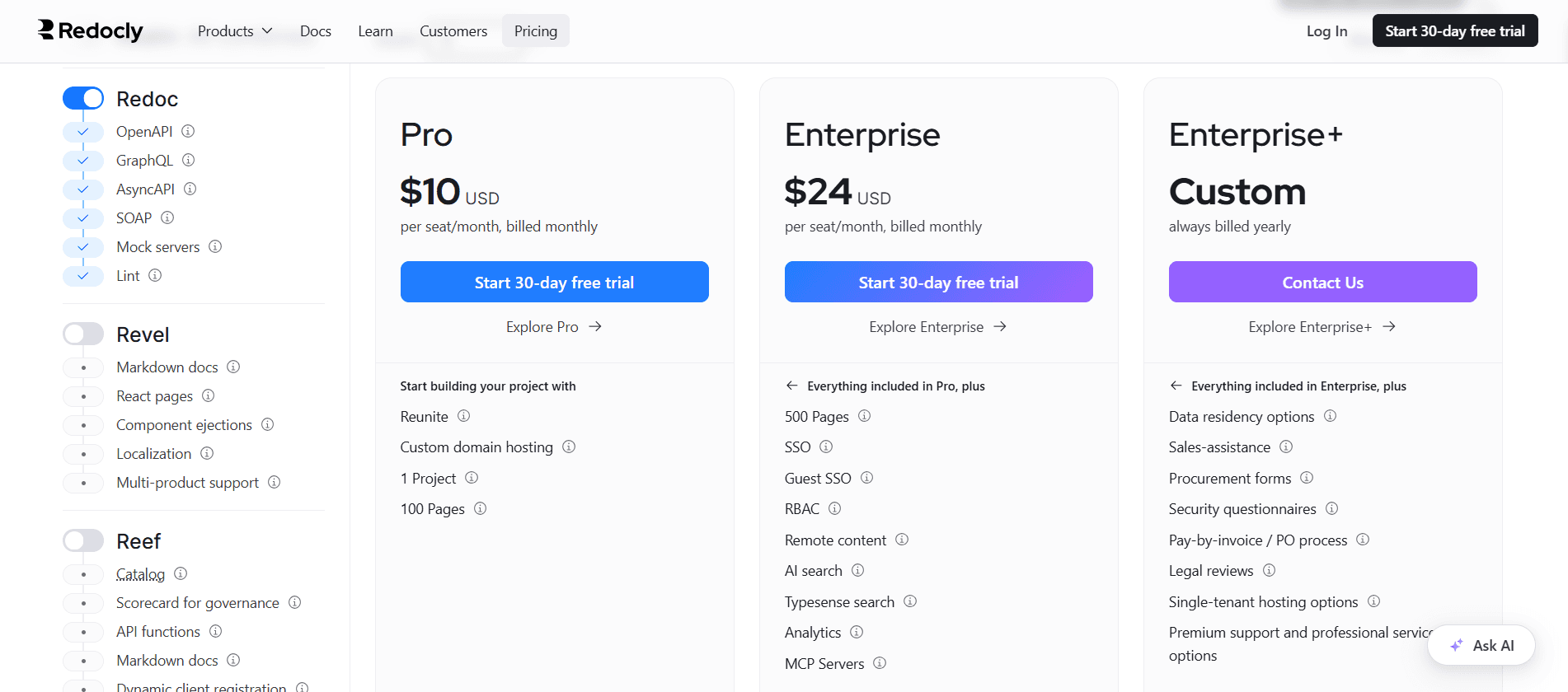
Three plans, charged per seat per month, with the rate set by how many of the three product modules you turn on. Pro and Enterprise both carry a published price and a checkout button, so Enterprise here is a self-serve purchase rather than a sales call. [1]
| Plan | 1 module | 2 modules | Realm, all 3 |
|---|---|---|---|
| Pro | $10 per seat/month | $20 per seat/month | $28 per seat/month |
| Enterprise | $24 per seat/month | $48 per seat/month | $66 per seat/month |
| Enterprise+ | Custom quote | Custom quote | Custom quote |
Those are the monthly rates Redocly shows by default. On yearly billing the same seats cost: [1]
| Plan | 1 module | 2 modules | Realm, all 3 |
|---|---|---|---|
| Pro | $108 per seat/year | $216 per seat/year | $300 per seat/year |
| Enterprise | $264 per seat/year | $528 per seat/year | $708 per seat/year |
| Enterprise+ | Always billed yearly | Always billed yearly | Always billed yearly |
Two allowances sit underneath every plan, and neither quietly invoices you. Projects are bought in advance, and pages, the only metered item, stop your deployments when the budget runs out: [1] [2]
| Meter | Pro | Enterprise | Enterprise+ | Beyond the allowance |
|---|---|---|---|---|
| Projects, each one a website | 1 | 1 | 1 | $49 per project/month |
| Pages, each route counts | 100 | 500 | 500 | $0.12 per page/month |
| Readers and viewers | Unlimited | Unlimited | Unlimited | Free, always |
The module multiplies the seat price rather than sitting beside it, each API operation counts as a page, and reader AI sits on Enterprise with a fixed organization-wide quota. [2] Each of those is priced out below.
If you would rather defend one workspace price than a per-seat formula, Documentation.AI puts reader AI, analytics, the MCP servers, and unmetered pages inside the plan rather than a tier above it. [3]
How Does Redocly's Pricing Work?
You buy seats. Redocly sets the rate for each seat from your plan and the number of modules you turned on, then adds documentation websites past the first and pages past your allowance. Nothing else on the platform is metered.
A seat is any account with the Owner, Member, or Committer role. The Billing and Viewer roles are free, and so is every reader of your published site. [2] Redocly is explicit about why it draws the line there: when it moved off its old Workflows platform it stopped charging for participants and started charging only for people who contribute. [2]
What Counts as a Seat
A seat rule catches teams out. A committer active in the last 30 days who is not linked to an existing member account uses a seat of their own, so a developer whose Git identity differs from their Redocly login can be billed twice until the two accounts are linked. [2]
Size the plan against what happens when you run out, because Redocly blocks rather than bills: [2]
- Seats. Once you reach your purchased seats you cannot invite anyone else, and with SSO just-in-time signup the new person cannot log in at all. Seats are billed in advance.
- Pages. When you pass your page budget, no further deployments run until you either cut pages or raise the budget.
- Projects. Past your project count, you cannot create another until you buy one.
The 30-Day Trial and How Billing Starts
Creating an organization starts a 30-day free trial with full access to every feature and no credit card. You subscribe from the Billing tab whenever you are ready, and pick your product, plan, and billing period at that point. [2] Plan changes take effect immediately and are prorated, and payment by invoice, check, or wire is available only on Enterprise+. Everyone else pays by card. [2]
Ignore any Workflows pricing you find. Redocly retired its previous platform, Workflows, on 28 February 2026, and everything on this page describes Reunite, the platform that replaced it. [2] Redocly still hosts a legacy Workflows pricing page, and its plan names and figures no longer apply to anything you can buy.
Redoc, Revel, Reef & Realm: How Each Module Affects Pricing
Redocly pricing turns on this. Redocly unbundled its platform into three modules that each carry the full per-seat price, and Realm is the bundle of all three at a discount. [1] [2]
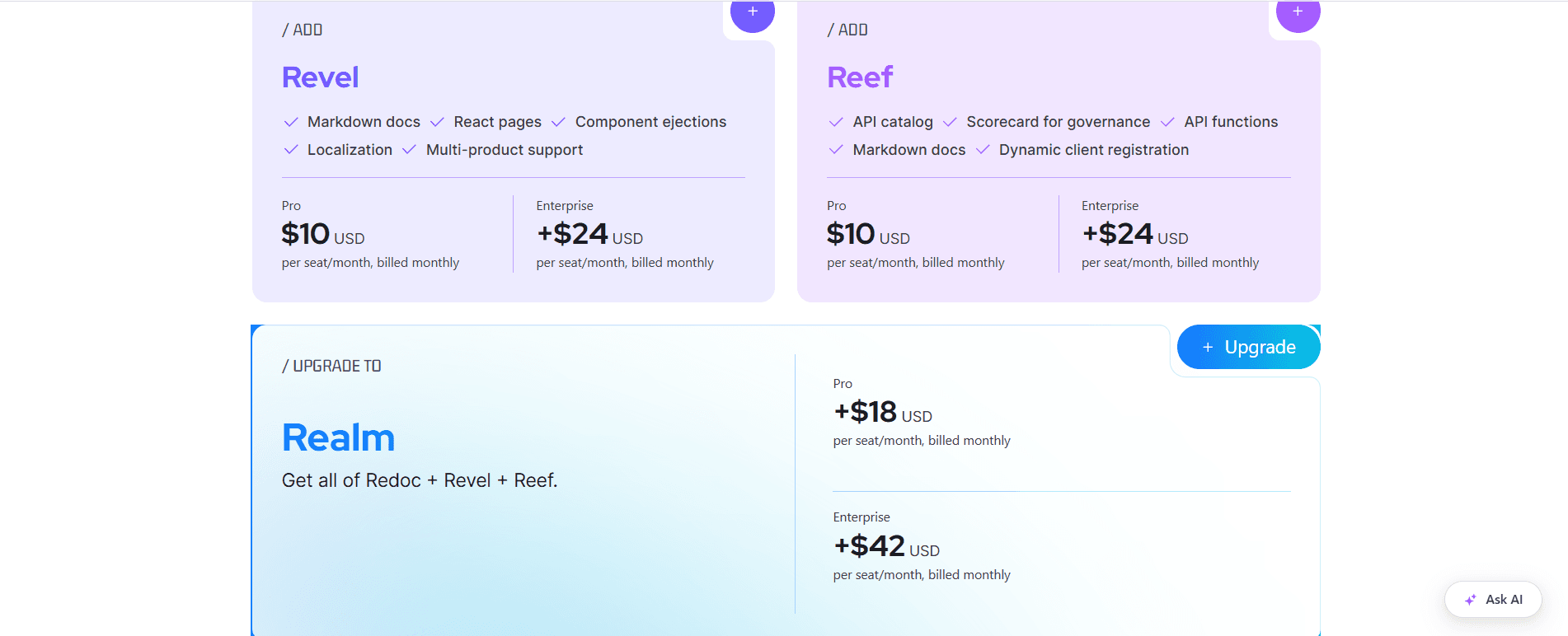
| Module | What it covers | Pro add | Enterprise add |
|---|---|---|---|
| Redoc | OpenAPI, GraphQL, AsyncAPI, and SOAP rendering, mock servers, and lint | $10 base | $24 base |
| Revel | Markdown docs, React pages, component ejections, localization, and multi-product | +$10 | +$24 |
| Reef | API catalog, governance scorecard, API functions, Markdown docs, and dynamic client registration | +$10 | +$24 |
| Realm | All three together | $28 total | $66 total |
Reunite sits underneath all of them and is not priced separately. It is the hosting, the web editor, the visual review tooling, the feedback reports, and the remote content automations, and you get it with any module you buy. [2]
Which Module Do You Actually Need
Redocly's own guidance is the clearest thing it publishes on this. Writing user documentation with no API reference means Revel alone. Publishing only API reference content means Redoc alone. Wanting both means Redoc plus Revel, and adding an internal catalog means Realm. [2]
That list hides traps. Markdown docs appear in both the Revel and Reef feature lists, so an internal platform team that needs a catalog and some prose may not need Revel at all. And Redoc on its own renders your OpenAPI file and nothing else, with nowhere to put a getting-started guide, which is the usual reason a team that budgeted $10 a seat ends up at $20.
Realm Is a Discount, Not a Tier
Three modules bought individually on Pro would be $30 a seat and Realm is $28. On Enterprise, $72 becomes $66. [1] That is a 7 to 8 percent saving, so it should not decide anything on its own. If you are unsure whether you need Reef's catalog, the cheaper experiment is two modules at $20 a seat, because Redocly lets you change the combination later and prorates the difference. [2]
What's Free? Redoc, Redocly CLI & Open-Source Tools
Redocly has no free hosted plan. What it has instead is a set of open-source tools that do real work, free forever with no seat count, alongside the 30-day trial of the paid platform. [2]
| Tool | What it does | Cost |
|---|---|---|
| Redoc | Renders an OpenAPI description as a documentation site | Free, open source |
| Redocly CLI | Lints, bundles, previews, and builds static docs | Free, open source |
| Respect CLI | Contract-tests your API against Arazzo workflows | Free, open source |
| Respect Monitoring | Hosted, scheduled contract monitoring with alerts | 1,000 requests a month free |
| Reunite hosting, editor, and reviews | The paid platform | 30-day trial, then paid |
Redocly is candid about where the line falls. Its own comparison post says open-source Redoc renders OpenAPI and nothing else, while premium Redoc adds GraphQL, AsyncAPI, and SOAP rendering, mock servers, the Replay try-it console, generated code samples, versioning, deep linking, advanced search, x-rbac and x-badges support, SEO control, and a broken link checker. [2]
Respect Monitoring, the One Usage-Based Product
API monitoring is the only part of Redocly priced by request rather than by seat, and it is a separate purchase from your documentation, so skip this section if you are only pricing docs. The first 1,000 requests a month are free, then $10 per 1,000, and a commitment lowers the rate: [1]
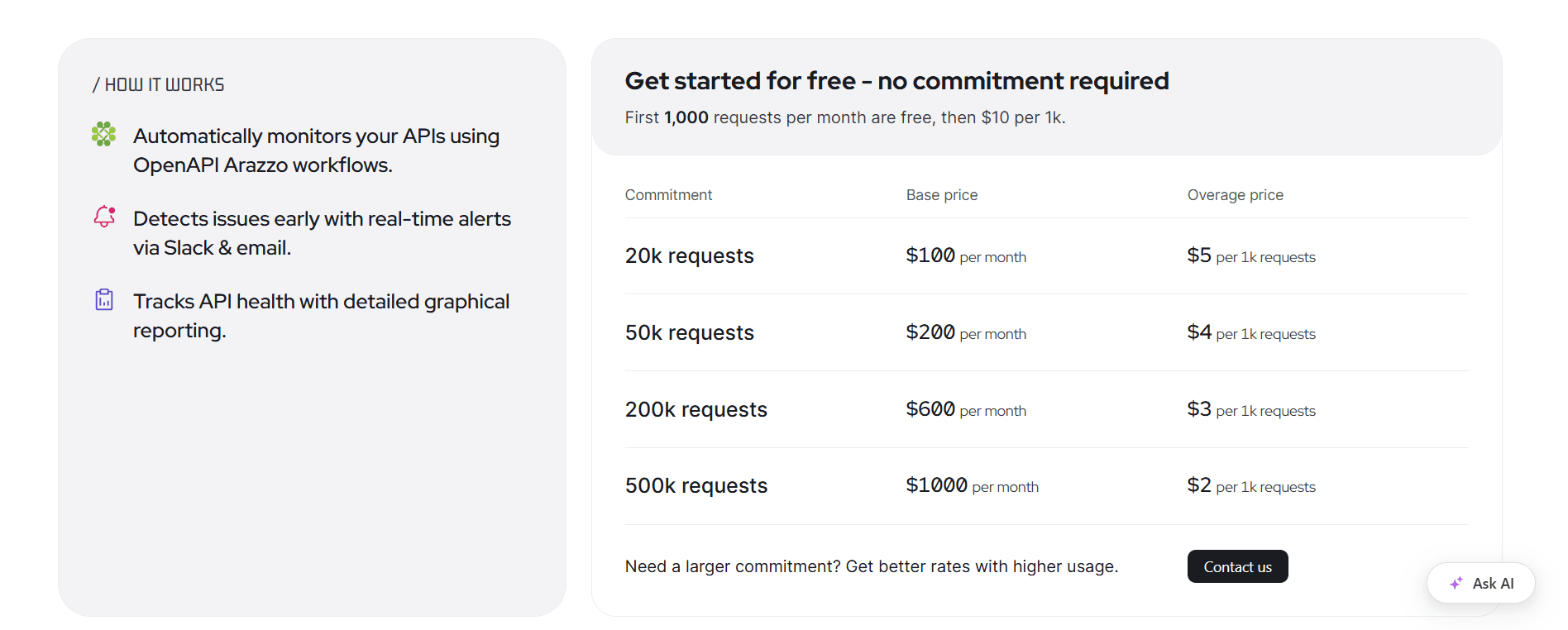
| Commitment | Base price | Overage |
|---|---|---|
| Pay as you go | None | $10 per 1k requests |
| 20,000 requests | $100/month | $5 per 1k |
| 50,000 requests | $200/month | $4 per 1k |
| 200,000 requests | $600/month | $3 per 1k |
| 500,000 requests | $1,000/month | $2 per 1k |
At 20,000 requests a month, pay-as-you-go costs $190 once the free 1,000 are used against $100 for the commitment, so the first tier pays for itself at roughly 11,000 requests. A check that only needs to run in CI does not need this subscription at all, because contract testing is already in the free Respect CLI. [1] [2]
What Does Redocly Cost for a Real Team?
Anywhere between $120 and $34,020 a year, and what moves you up that range is rarely headcount on its own. It is the module you add, the second website you launch, or the one Enterprise feature you cannot do without. Five teams, priced at Redocly's published rates, monthly and annualized: [1]
| The team | Configuration | Per month | Per year |
|---|---|---|---|
| A solo writer publishing one API reference | Pro, Redoc, 1 seat, 80 pages | $10 | $120 |
| A three-person team publishing reference plus guides | Pro, Redoc + Revel, 3 seats, 150 pages | $66 | $792 |
| An eight-person docs team running two product sites | Pro, Realm, 8 seats, 2 projects, 400 pages | $309 | $3,708 |
| The same team, now needing Ask AI, SSO, RBAC, and analytics | Enterprise, Realm, 8 seats, 2 projects, 400 pages | $577 | $6,924 |
| A 40-seat platform team running four portals | Enterprise, Realm, 40 seats, 4 projects, 2,000 pages | $2,835 | $34,020 |
The third and fourth rows are the same eight people publishing the same 400 pages. The only thing that changed is the plan, and the bill went up by $268 a month, or $3,216 a year, to buy reader AI, single sign-on, content-level access control, and a documentation analytics dashboard.
Those annual figures are the monthly rate times 12. Commit to annual billing and the seat portion drops to the yearly rates, so the eight-person Enterprise Realm team pays $5,664 a year in seats instead of $6,336, taking that fourth row to roughly $6,250. [1]
The Enterprise Seat Bands
Pro is a flat rate at any headcount. Enterprise steps down in graduated bands, so crossing a threshold discounts only the seats above it: [1]
| Seats | Redoc alone | Realm |
|---|---|---|
| 1 to 20 | $24 per seat/month | $66 per seat/month |
| 21 to 50 | $21.60 | $59.40 |
| 51 to 100 | $19.20 | $52.80 |
| 101 to 250 | $16.80 | $46.20 |
| 251 to 500 | $15.60 | $42.90 |
| 501 to 1,000 | $14.40 | $39.60 |
| 1,001 and above | $13.20 | $36.30 |
The floor is 45 percent below the entry rate, and Redocly publishes the whole curve rather than making you ask for it. It only starts to matter above 20 contributors, and most documentation teams never get there.
The Same Team, Priced Against Documentation.AI
One charges per seat and the other per workspace, so compare them at a stated team size: [1] [3]
| Redocly | Documentation.AI | |
|---|---|---|
| Free plan | None, 30-day trial only | Yes, 5 editor seats |
| Entry paid price | $10 per seat/month, one module | $55/month for the whole workspace |
| Five seats, reference plus guides | $100/month, Pro with Redoc and Revel | $55/month, Standard |
| Eight seats with reader AI switched on | $528/month, Enterprise Realm | $159/month, Pro |
| Editor seats | Every contributor billed, no volume discount on Pro | 10 on Standard, unlimited on Pro |
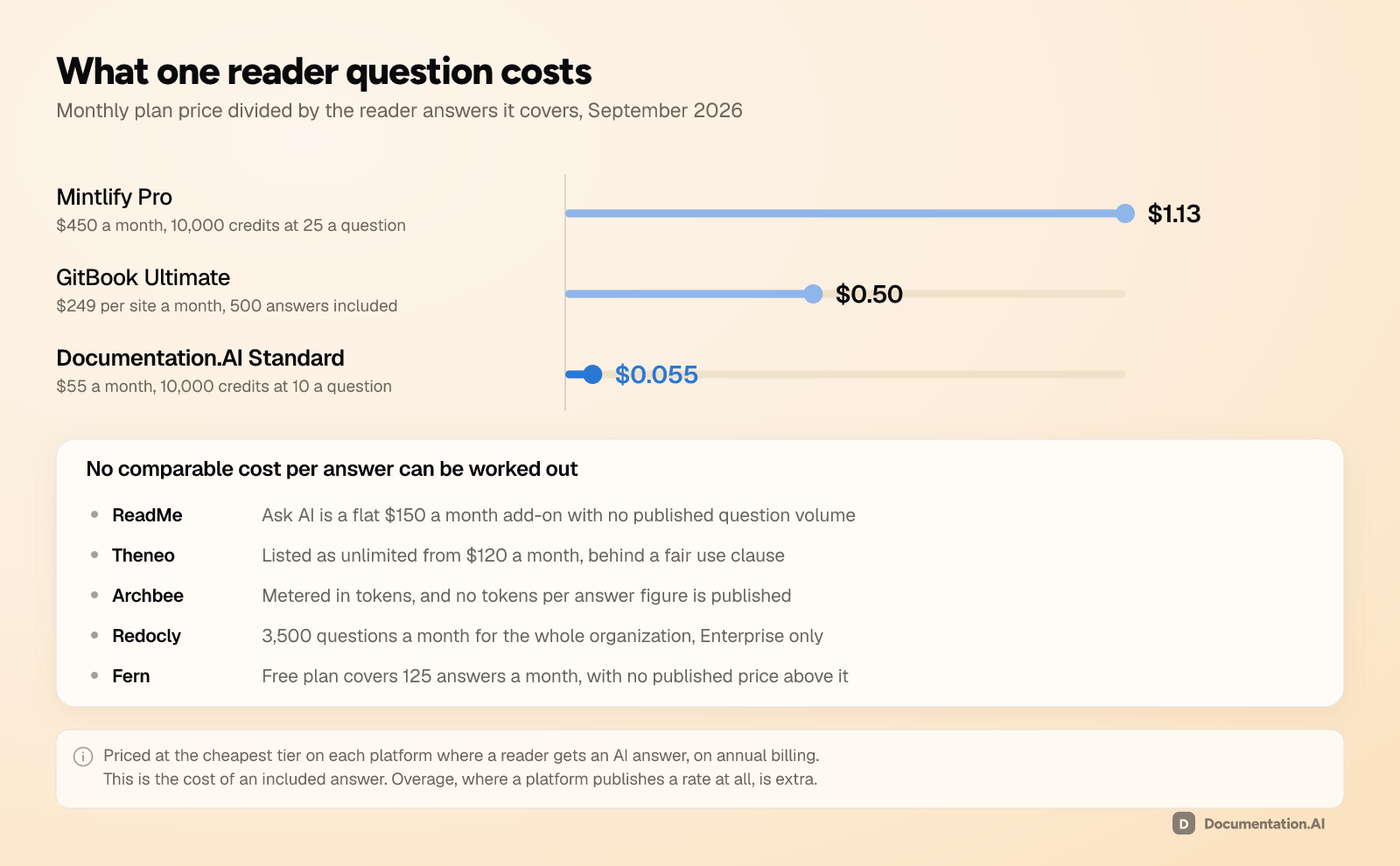
| Reader AI | Enterprise only, 3,500 questions/month per organization | Included from free, 10 credits per question |
| Docs MCP server | Enterprise only | Every plan, including free |
| Documentation analytics | Enterprise only | Included, advanced analytics on Pro |
| Content-level RBAC | Enterprise only | Pro, $159/month |
| Reader login over JWT or OAuth | Enterprise only | Pro, $159/month |
| Second documentation site | $49/month | Included, 2 projects on Standard and 4 on Pro |
| Page limits | 100 on Pro, 500 on Enterprise, then $0.12 each | None |
| Markdown docs and landing pages | Revel module, doubles the seat rate | Included |
The $10 headline holds for one shape: one person, one OpenAPI file, under 100 pages, no prose, no analytics, and no AI. Add a writer, a getting-started guide, a second product, and an Ask AI button, and the same team is on Realm Enterprise. The eight-person team above pays $577 a month for a setup that sits inside Documentation.AI Pro at $159 with unlimited editor seats, because Redocly prices capability per person and per module, and multiplies. [3]
Price your own configuration both ways. Start free on Documentation.AI and import the OpenAPI file you would publish on Redocly. Ten minutes gives you a like-for-like number instead of an estimate.
Redocly Enterprise & Enterprise+ Pricing
Enterprise is $24 a seat a month, or $264 a seat a year, and you can buy it with a credit card. Enterprise+ is a quote. That split matters, because the product sits on the self-serve side of the line and only the procurement work sits behind sales. [1]
Enterprise adds nine things to Pro, and this is the full published list: [1]
- 500 pages instead of 100, which is often the real reason a team upgrades.
- SSO with SAML 2 or OIDC for your own team.
- Guest SSO, a separate identity provider category for authenticating external readers into protected projects. [2]
- RBAC, applied to pages, path patterns, and even sections within a page. [2]
- Remote content, which pulls content into your project from other Git repositories, URLs, or CI processes. [2]
- AI search, now called the AI assistant, capped at 3,500 questions a month per organization. [2]
- Typesense search, an alternative engine with faceting and filtering. [2]
- Analytics, the page views and search query dashboard inside Reunite. [2]
- MCP servers, which expose your documentation and API descriptions to AI tools. [2]
Enterprise+ adds no product features at all. It adds data residency options, single-tenant hosting, premium support and professional services, tiered volume discounts, and the commercial machinery large buyers need: sales assistance, security questionnaires, legal contract reviews, procurement forms, and payment by invoice or purchase order. [1] If you do not need any of that, Enterprise is the ceiling and you can reach it without talking to anyone.
What the AI Quota Really Means
The AI assistant's 3,500 questions a month is an organization-wide figure that does not scale with your seat count or your bill, so a 10-seat team and a 400-seat team get the same allowance. Above it, readers fall back to regular search results rather than an error or an overage charge, and Redocly publishes no way to buy more. [2] Model it against your actual traffic before you count reader AI as a reason to upgrade.
A fixed quota is also why Redocly cannot be given a cost per reader question: there is no allowance that moves with the price to divide.
The SLA covers self-serve customers too. Redocly's Service Level Agreement is incorporated into the standard Subscription Agreement rather than an Enterprise addendum, so it applies from the $10 plan up. It commits to 99.9% monthly uptime and an average 24-hour support response, with a corrective action plan on request if either is missed. [2]
What to Consider Before Choosing a Redocly Plan
Five questions settle your number, and Redocly's plan cards answer only one of them.
- How many pages will you publish? Count your API operations first, because each one is a page, and this number decides whether Pro is viable. [2]
- Which modules do you need? Every module adds a full per-seat rate, so buying Revel because someone might write a tutorial is the most expensive shrug in this pricing model.
- Is anything on your list Enterprise-only? Reader AI, analytics, RBAC, SSO, remote content, or the MCP server sets your floor at $24 a seat.
- How many separate websites do you publish? A second one is $49 a month on any plan.
- How many people commit to your docs repository? Redocly counts committers, not writers, so engineers who touch an OpenAPI file once a month are seats. [2]
Three places in Redocly's own material contradict each other on figures that change your bill: [1] [2]
- The Pro product page promises "two projects, your main stage and your playground". The pricing page, the calculator, and the billing FAQ all say one project is included.
- The Pro product page lists analytics among its features. The pricing page lists Analytics as something Enterprise adds.
- The calculator says the extra page price tiers down with volume. The rate it applies stays at $0.12 at any volume.
None of these is a trap so much as a marketing site that has drifted away from the billing system. Ask sales to confirm all three in writing before you size the plan around any of them.
What Switching Away From Redocly Actually Costs
The strongest argument for staying is not the price. It is that your documentation already lives in Git, your OpenAPI description is the source of truth, and redocly lint runs in CI on every pull request. Most of that moves: Markdown and MDX are portable, Documentation.AI keeps bidirectional Git sync so pull requests still gate what publishes, and OpenAPI descriptions import directly and generate the reference pages. [3]
Two things do not move. Redocly CLI lint rules and decorators use Redocly's own configuration format, and React components ejected in Revel do not port at all. The first matters less than it looks, because Redocly CLI is open source and host-agnostic, so a team can keep linting and bundling in CI and publish somewhere else. [2]
Is Redocly Worth the Cost?
If your product is an API and your documentation is mostly its reference, Redocly is fair at $10 a seat, and one subscription covers mock servers, lint, an Arazzo-aware contract tester, and a governance scorecard. [1] [2] The model turns on you when documentation stops being only the reference, because guides, a second product, and every Enterprise feature are multiplied by headcount rather than absorbed by the subscription.
So price the shape you are heading toward, not the one you have. On Documentation.AI the AI assistant, the MCP servers, analytics, and unmetered pages come with the plan, and there is a free tier to build on rather than a 30-day window. [3] Start free and put your own OpenAPI file through it this afternoon.
Related Redocly Comparisons
Pricing is one input. These put the rest of the field on the same footing, on features and workflow as well as cost:
- Redocly review 2026, the hands-on assessment of the editor, Git workflow, AI, and analytics, with scores
- Redocly vs Documentation.AI, the same documentation built on both platforms
- Mintlify pricing, where reader AI is sold in credits rather than gated by tier
- ReadMe pricing, the other platform that sells reader AI separately
- GitBook pricing, billed per site and per user
- Archbee pricing, where seven capabilities are sold as add-ons, six of them at $80
- Theneo pricing, the other vendor that caps your API's endpoint count
- Best API documentation tools, the whole category compared at once
FAQs
1. How Much Does Redocly Cost?
Per seat per month, set by plan and module count. Pro is $10, $20, or $28 a seat for one, two, or all three modules, and Enterprise is $24, $48, or $66, with lower rates on yearly billing. Enterprise+ is a custom quote. On top of seats you pay $49 a month per extra documentation website and $0.12 a month per page past your allowance.
2. Is Redocly Free?
There is no free hosted plan. Redoc, Redocly CLI, and Respect CLI are free and open source, Respect Monitoring includes 1,000 requests a month, and the hosted platform starts with a 30-day trial that needs no credit card.
3. Does Redocly Charge per User or per Site?
Per user, with sites metered separately. Owners, Members, and Committers take seats, while the Billing and Viewer roles and every reader are free. One documentation website is included on every plan, and each additional one is $49 a month.
4. What Is the Difference Between Redoc, Revel, Reef, and Realm?
Redoc renders API descriptions, with mock servers and lint. Revel adds Markdown, React pages, localization, and multi-product support. Reef adds an API catalog, a governance scorecard, and API functions. Realm bundles all three at $28 a seat on Pro, against $30 bought separately.
5. Does Redocly Charge Extra for AI?
Not as a line item, but the AI assistant is Enterprise and Enterprise+ only, so reaching it means at least $24 a seat. The quota is 3,500 questions a month for the whole organization, after which readers get regular search results instead of an overage charge.
6. How Does Redocly Count Pages?
Every route in your published site is a page, and each API operation is a route, so a 300-operation description is 300 pages before any prose. Pro includes 100 pages and Enterprise 500, then each page is $0.12 a month.
7. Is Redocly Expensive Compared to Other Documentation Tools?
It depends on modules and contributors. One writer publishing one OpenAPI file on Pro costs $10 a month, while an eight-person team on Realm Enterprise with two sites costs $577 a month. The variable is people multiplied by modules, not traffic.
8. Can You Migrate Away From Redocly?
Mostly, as files. Markdown, MDX, and OpenAPI descriptions move to any host with Git sync, while Redocly's lint configuration and ejected React components do not. Redocly CLI stays free, so you can keep linting in CI wherever you publish.
Sources
- Redocly. "Pricing" and "Estimate your bill." Redocly. Accessed September 2026. https://redocly.com/pricing
- Redocly. "Redocly Docs." Redocly. Accessed September 2026. https://redocly.com/docs
- Documentation.AI. "Pricing." Documentation.AI. Accessed September 2026. https://documentation.ai/pricing
Counting seats?
No page caps, no per-seat AI
Reader AI, analytics, and the MCP servers are in the plan, and pages are not metered. Import your spec.
Start freeNo credit card required