Comparisons · · 14 min read
Theneo Pricing 2026: Plans, Limits & Real Cost
Theneo bills per workspace rather than per seat, and limits projects, developer portals, and API endpoints by plan. This guide explains what each tier allows, how its unlimited AI is qualified, and which capabilities are priced only on request.

Monika B.
GTM Engineer, Documentation.AI
On this page
- Theneo Pricing at a Glance
- How Does Theneo's Pricing Work?
- What Theneo Meters: Projects, Endpoints, and Portals
- What Do Theneo's AI Features Cost?
- The Theneo Prices That Are Not Published
- What Does Theneo Cost for a Real Team?
- Theneo Enterprise Pricing
- What to Consider Before Choosing a Theneo Plan
- Is Theneo Worth the Cost?
- Related Theneo Comparisons
- FAQs
- Sources
Theneo publishes two prices, $120 and $400 a month, and it does not charge you per seat.
The bill still is not those two numbers. Theneo caps your public projects, your developer portals, and your API's endpoint count, which puts the size of your product on your documentation invoice, and four more capabilities carry no published price at all.
This guide prices the plans, then prices everything that sits beside them. Every figure comes from Theneo's own pricing page and product documentation.
Theneo Pricing at a Glance
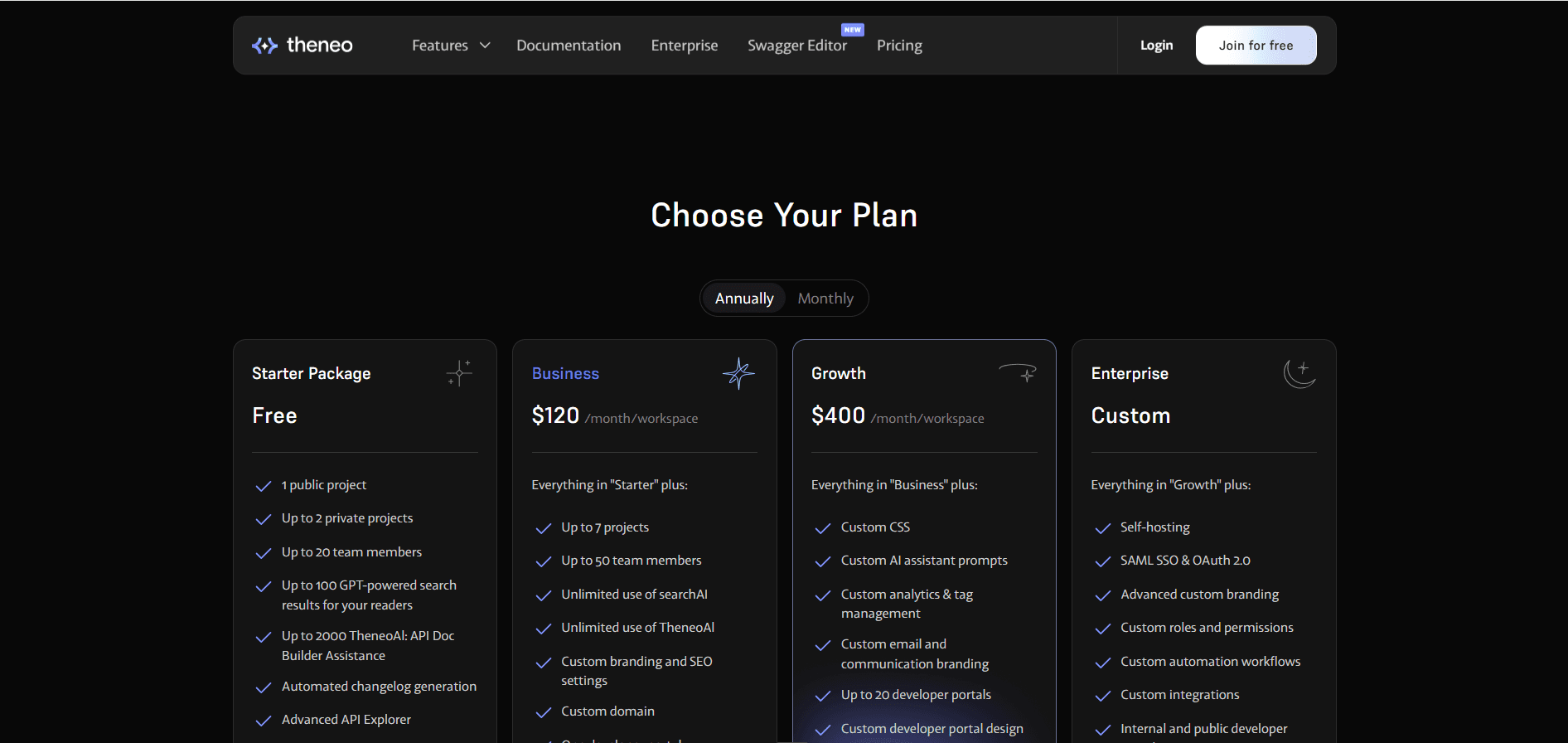
Four tiers, billed per workspace rather than per site or per seat, which is why the seat column below carries no price: [1]
| Plan | Price | Projects | Team members | API endpoints |
|---|---|---|---|---|
| Starter | $0 | 1 public, 2 private | Up to 20 | Up to 2,000 |
| Business | $120 per workspace/month | 2 public, up to 5 private | Up to 50 | Up to 5,000 |
| Growth | $400 per workspace/month | Up to 10 public, up to 10 private | Up to 100 | Up to 10,000 |
| Enterprise | Custom quote | Unlimited | Unlimited | Unlimited |
Monthly billing is charged at a different rate to the annual one quoted here.
The feature gates matter more than the plan names. This is where each capability actually starts: [1]
| Capability | Starter | Business | Growth | Enterprise |
|---|---|---|---|---|
| Custom domain and brand editor | ✗ | ✓ | ✓ | ✓ |
| Password-protected projects | ✗ | ✓ | ✓ | ✓ |
| Global CSS and JavaScript | ✗ | ✗ | ✓ | ✓ |
| Custom developer portal design | ✗ | ✗ | ✓ | ✓ |
| Postman sync | ✗ | ✗ | ✓ | ✓ |
| Workspace groups and Slack support | ✗ | ✗ | ✓ | ✓ |
| Remove "powered by Theneo" | ✗ | ✗ | ✗ | ✓ |
| Theneo API access | ✗ | ✗ | ✗ | ✓ |
| SAML SSO, Okta, and JWT reader login | ✗ | ✗ | ✗ | ✓ |
| Custom roles and permissions | ✗ | ✗ | ✗ | ✓ |
| Self-hosting | ✗ | ✗ | ✗ | ✓ |
Four details from those two tables change the arithmetic before you start:
- Seats are included, not billed. Twenty people on the free plan, 50 on Business, and 100 on Growth, at no per-head cost. Most of the category charges $12 to $20 a head every month, so this is the strongest thing about Theneo's pricing and the reason a large team can land on a cheaper tier than it expects.
- Your project allowance is split, and the public half is the small half. Business advertises seven projects, but only two of them can be public. A company with three public API references cannot publish them all on the $120 plan, whatever the headline number says.
- The free plan cannot use your domain. Custom domain, brand editor, and password protection all start at Business, so a free Theneo site lives on a Theneo URL and looks like one.
- Endpoints are capped by plan. Nothing else in this category prices your documentation against the size of your API. Most teams will never see the ceiling, and a large platform with several versioned services can.
If a flat number you can defend to a budget owner matters more than any single feature above, it is worth seeing the other shape this can take. Documentation.AI does not cap endpoints, does not split projects into public and private allowances, and puts reader-facing AI on the free plan, so your cost does not move when your API or your traffic does. [2]
How Does Theneo's Pricing Work?
The hierarchy is workspace, then projects, then sections. A project is one body of documentation, usually one API or one product, and a single workspace holds several of them, so a second product costs nothing until it crosses one of the caps above. Most platforms in this category would charge you again for it.
The part to plan for is what happens when one workspace stops being enough. Because the price is quoted per workspace, two brands or two business units that each need their own are two full subscriptions, and nothing carries across between them, including branding, members, and analytics.
The Workspace Decision You Cannot Reverse
Theneo asks you to pick Personal or Corporate when you create a workspace. Corporate is what unlocks inviting members, sharing private projects, and domain whitelisting, and it costs nothing on the free tier. [3]
Choose Corporate at signup. The upgrade from Personal runs one way only, and Theneo's documentation states it plainly: the change "is permanent, there's no step back, and you can't switch Corporate to Personal." It is the one setup decision here you make only once, so a workspace opened as Personal during a quick trial cannot later become the shared one your team works in. [3]
Billing, Cancellation, and Refunds
Fees are billed in advance and renew automatically until you cancel, and none of the plan cards mention what happens after that. The terms of service do, and four points there matter more than any feature on the comparison table: [4]
- Nothing is refundable. Payments for the current cycle are non-refundable, and the terms separately rule out prorated refunds, set-off, and credit for unused time, including on cancellation and downgrade.
- Cancelling takes effect at the end of the cycle. You keep paid features until the period you have already paid for runs out.
- Cancelling downgrades rather than deletes. The account drops to the free plan and your projects and content are retained, subject to free-plan limits.
- A failed payment suspends paid features, and if it stays unresolved for a month the account is downgraded to free, which the terms treat as terminating your paid subscription.
Price changes only ever land at renewal rather than mid-cycle, which is fairer than most, and billing discrepancies have to be raised within 30 days.
There is also no trial of the paid tiers to fall back on. Theneo's FAQ says there is "a genuinely free Starter plan rather than a time-limited trial," [5] which never expires but also withholds the custom domain, the brand editor, and reader AI past 100 answers, so the features you are actually paying for cannot be tested before you buy them. Between that and non-refundable annual billing, the tier you pick is a 12-month decision made on the strength of a demo. Put your real spec through a free plan on both platforms first: start free on Documentation.AI takes an OpenAPI import and a custom domain without a card.
What Theneo Meters: Projects, Endpoints, and Portals
Theneo caps three things by plan: how many projects you publish, how many developer portals you run, and how many endpoints your APIs contain. Only the first has an equivalent elsewhere in the category, and the last one moves with your engineering roadmap rather than your documentation.
Projects, Public and Private
| Starter | Business | Growth | Enterprise | |
|---|---|---|---|---|
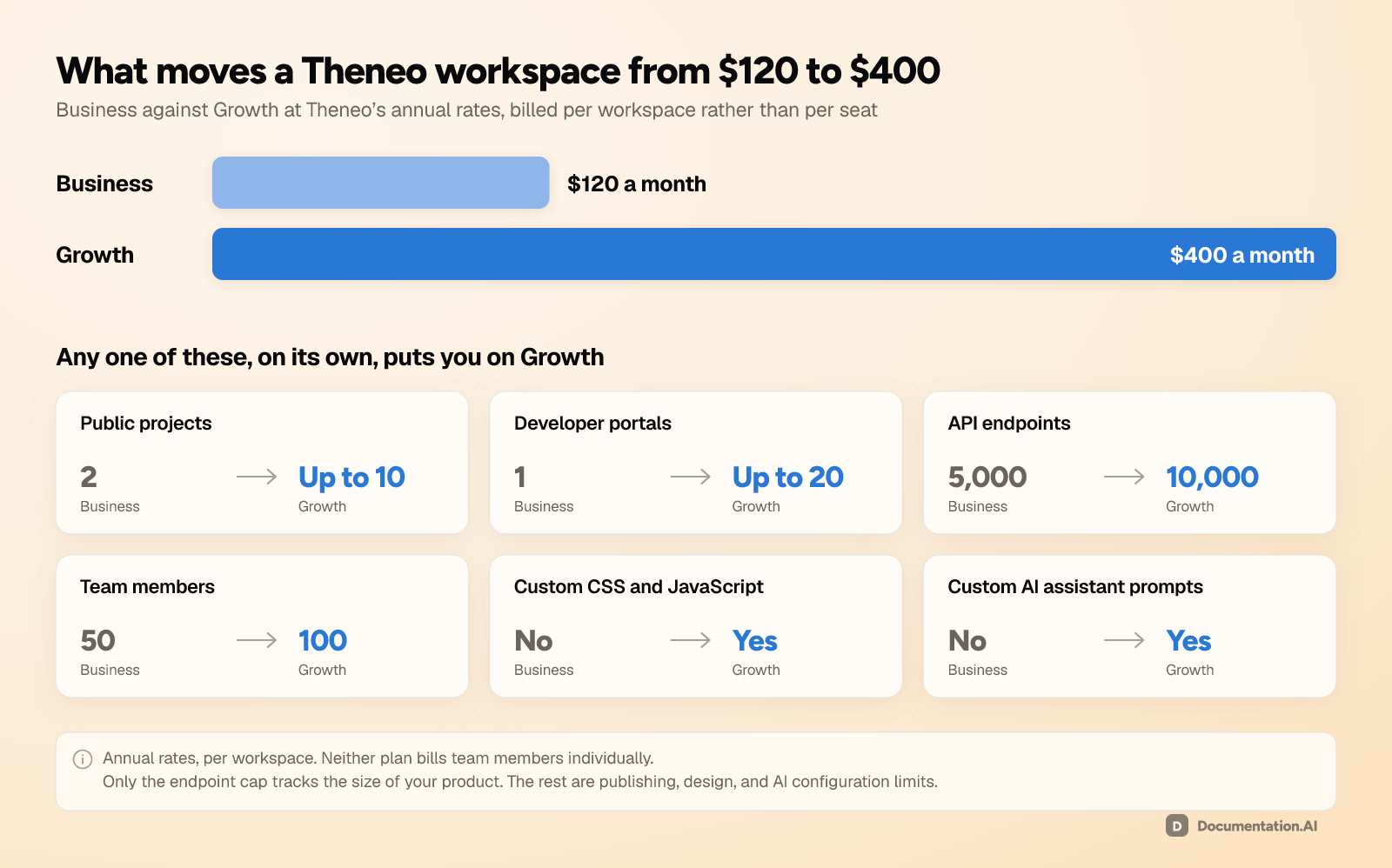
| Public projects | 1 | 2 | Up to 10 | Unlimited |
| Private projects | 2 | Up to 5 | Up to 10 | Unlimited |
Read that as a publishing limit rather than a storage limit. [1] Private projects are drafts, internal documentation, and partner content that nobody outside your workspace reads. Public projects are the ones your customers land on, and Business gives you two.
That is the line that pushes teams from $120 to $400.
Developer Portals
The developer portal is the branded hub that sits in front of your references, guides, and changelogs, built in a low-code editor that also accepts your own HTML and CSS. Business covers a single portal, while Growth raises that to 20 and is the first tier where you can design one yourself instead of starting from a template. [1] [3] Most companies need only the one, so this turns into a $400 decision when partners and public developers require separate hubs.
API Endpoints
The cap is 2,000 endpoints on Starter, 5,000 on Business, and 10,000 on Growth, with Enterprise unlimited, and it counts every operation across every version of every API in the workspace. [1] Nothing else in the category meters this, so check it against your real spec before you commit. Five thousand operations is ample for one REST API and tight for a platform running a dozen versioned services alongside its internal ones.
What Do Theneo's AI Features Cost?
Reader-facing AI search and the AI doc builder both carry caps on the free plan, and from $120 a month per workspace the pricing page lists them as unlimited, with no answer allowance, no credit balance, and no published overage rate. [1] Four qualifications sit behind that word, and the pricing page states none of them.
| Plan | What the AI does |
|---|---|
| Starter, $0 | Ask AI live on your docs, capped at 100 GPT-powered search results for readers and 2,000 TheneoAI doc builder assists for writers |
| Business, $120 per workspace/month | Unlimited searchAI for readers, unlimited TheneoAI for writers |
| Growth, $400 per workspace/month | Adds custom AI assistant prompts |
| Enterprise | Adds private customer portals and custom automation workflows |
What "Unlimited" Does Not Cover
- A fair use clause sits behind the word. Theneo's terms let it throttle your usage, require an upgrade, invoice you for excess usage, or suspend the affected functionality if your usage exceeds your plan or places a disproportionate load on the platform, and it reserves the right to adjust plan limits over time. [4] No threshold for any of that is published, so "unlimited" means uncapped until Theneo decides otherwise.
- The free caps have no stated period. Theneo does not say whether 100 search results and 2,000 assists reset monthly, reset annually, or are a one-time grant. [1] At 100 answers the free plan is an evaluation rather than a live public docs site.
- Embedding Ask AI outside your docs is priced by request. Theneo documents exporting the assistant into your own product or site, then says export and embedding are available on request. [3] No tier includes it.
- Custom AI prompts require Growth. On Business the assistant answers in the configuration Theneo ships, so tone, scope, and forbidden topics are a $400 feature.
Between the fair use clause and the missing reset period, there is no figure here you can divide into a cost per reader question. That is a real difference from the platforms that publish an allowance, and it cuts both ways:
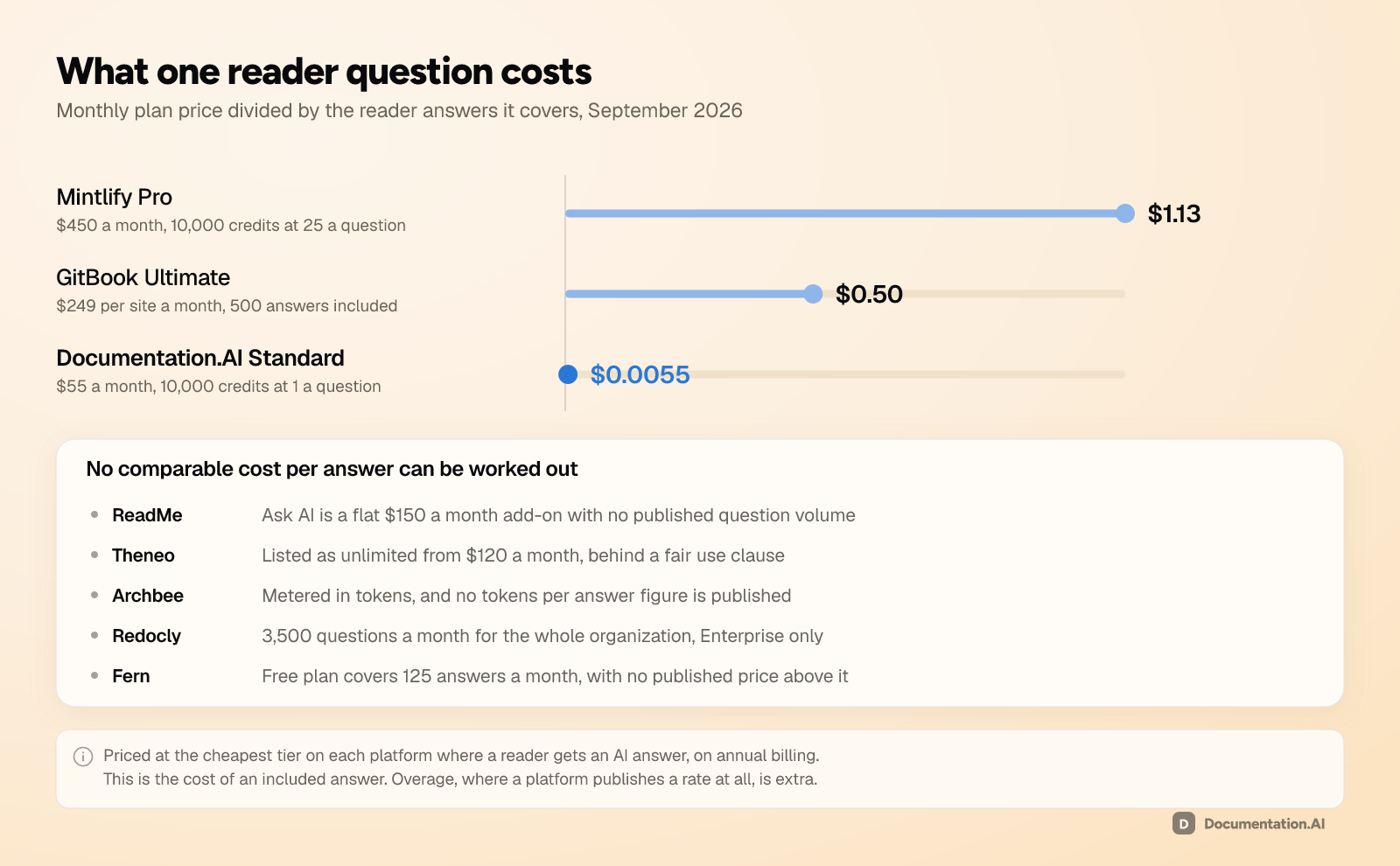
An uncapped plan with no published rate is the better deal right up until the fair use clause is invoked, and there is no way to price that moment in advance.
AI Analytics
Every Ask AI question is logged verbatim, alongside usage trends by date and page, recurring or poorly answered questions, and section-level ratings with comments. [3] Analytics switch on when you publish, on every plan including the free one, and the workspace dashboard rolls every project into one view.
The Theneo Prices That Are Not Published
Four capabilities have no published price, and three of them are things Theneo markets hard.
- The MCP API. Theneo's MCP server lets Claude or Cursor browse, search, read, edit, add, and delete sections of your documentation. Only browsing the project structure works out of the box; everything else needs the MCP API feature enabled for your workspace by email. [3]
- Ask AI export and embedding. Enabled by request rather than by tier. [3]
- AI translation. Localization is switched on per workspace by the Theneo team, with no word rate and no language count published. [3]
- Enterprise. Enterprise quote.
The pattern cuts against Theneo's own positioning. It markets itself as AI-native, yet the two AI capabilities that reach beyond your docs site, an agent that edits your documentation and an assistant that runs inside your product, are gated behind an email rather than a plan.
Documentation.AI draws that line differently. The AI Assistant, the Documentation Agent, self-updating AI workflows, and two MCP servers, one for readers and one for authoring, are in every plan including the free one, metered in credits rather than unlocked by request. [2]
What Does Theneo Cost for a Real Team?
What five different setups cost at Theneo's published rates: [1]
| Your setup | Plan | Per month | The catch |
|---|---|---|---|
| One public API reference, up to 20 writers | Starter | $0 | No custom domain, 100 reader AI answers, a Theneo-branded URL |
| One product on your domain, 50 writers, reader AI for all of them | Business | $120 | Two public projects, one developer portal, no custom CSS |
| Two brands, each on its own workspace | Two Business workspaces | $240 | Nothing carries across workspaces, including branding, members, and analytics |
| Three public products, custom portal design, IP allowlisting, 100 people | Growth | $400 | No Theneo API access, no SSO, and white labeling sits a tier above |
| Partner portals, SSO, self-hosting, white label | Enterprise | Quote | Every differentiating feature lives on this tier |
Every jump there is a publishing or branding limit, not a usage one, so your bill holds steady when traffic spikes or the team grows.
The Same Team, Priced Against Documentation.AI
| Theneo | Documentation.AI | |
|---|---|---|
| Entry paid price | $120 per workspace/month | $55/month |
| Editor seats | 20 free, 50 Business, 100 Growth, never per head | 5 free, 10 Standard, unlimited Pro |
| API endpoints | 2,000, 5,000, or 10,000 by plan | Not capped by plan |
| Public projects at entry | 2 | 2 |
| Custom domain | Business, $120/month | Every plan, including free |
| Reader AI | 100 answers free, then unlimited from $120 | Included from free, one credit per question |
| Docs MCP for your own writers | On request, no published price | Reader and authoring servers, every plan |
| Reader login over JWT or OAuth | Enterprise | Pro, $159/month |
| Branch, review, and approval workflow | Enterprise | Git branches and pull requests, every plan |
| AI translation | Enabled on request, no published price | Not offered |
Read that table honestly and it does not point one way. Theneo wins on seats outright, and if you have 40 writers and one API, $120 a month with reader AI nobody counts is hard to beat anywhere in this category.
Run it the other way and the gap flips. A team of 10 or fewer pays $55 a month on Documentation.AI against $120 on Theneo, gets a custom domain on the free tier where Theneo starts charging at $120 for one, and is never priced against the size of its API. That is the more common shape, and it is the half of the comparison Theneo's own page has no reason to show you. Start free and import your OpenAPI spec to price your own team this afternoon.
The clean way to decide is to ask which meter you will hit first. If it is headcount, Theneo is cheaper. If it is endpoints, public projects, or an SSO requirement, Theneo's answer is a tier jump and eventually a sales call, and Documentation.AI is the better fit, because none of those three is a billable ceiling there.
Working out which meter you would hit? Join the Documentation.AI Slack community and ask the people who have already migrated. It is a fast way to compare notes on OpenAPI imports, redirects, and what documentation tooling really costs at your size.
Theneo Enterprise Pricing
No published price and no reliable third-party figure, so treat any number you find elsewhere as a rumor. What matters is which requirements end the self-serve path, and on Theneo that list is longer than most: [1] [3]
- Identity. SAML SSO with Microsoft Entra ID, Okta, SCIM provisioning, end-user login with JWT, custom SSO flows, and custom roles and permissions are all Enterprise
- White label. The pricing table lists removing the "powered by Theneo" mark against Enterprise only, alongside custom API reference design and custom portal navigation and workflows
- Private customer portals. Partner-by-partner access on your domain with your branding, where the customer never sees Theneo and never needs a Theneo account, which is Theneo's most differentiated capability and sits on its top tier
- Documentation review. Branches, assigned approvers, merge rules, and inline comments on changes. The lighter-weight substitute below Enterprise is publishing rights, which restricts who can publish but does not give you a review
- Automation. Theneo API access, self-hosting, custom integrations, and custom automation workflows
- Procurement fit. A custom SLA and a dedicated customer success manager
Two items on that list do not require a quote everywhere. Reader login over JWT or OAuth and role-based permissions sit on Documentation.AI's $159 Pro plan, and review runs through git branches and pull requests on every tier including the free one. [2] SAML SSO is an enterprise conversation on both platforms, so if that is your only blocker, the tier jump is unavoidable either way.
One more cost sits in the documentation rather than the pricing page. Theneo's white-glove migration service is described as part of the Annual Growth Package, so hands-on help moving your docs across starts at an annual Growth commitment. [3] Self-serve import and URL redirect management are free on any plan.
What to Consider Before Choosing a Theneo Plan
Your number comes out of four questions. Work through them with your real spec and org chart open, because each one is a ceiling rather than a usage line, so crossing it means a tier jump rather than a slightly larger invoice.
- How many of your documentation projects are public? Count the sites your customers land on, not the ones sitting in your workspace.
- How many endpoints does your spec actually have? Add up every operation across every version of every API you intend to document, including the internal ones, then check it against the tiers.
- Do you need one workspace or several? Each workspace is a separate plan.
- Will you want the AI beyond your docs site? The MCP API, the embeddable assistant, and AI translation are all enabled by request. Get prices for the ones you want in the same email as your quote.
Is Theneo Worth the Cost?
Yes, for a large team documenting one API. At $120 a month, 50 included seats and reader AI with no published cap make Theneo hard to beat at that size, and the reader question log comes with the plan rather than as an add-on.
It stops being worth it when growth means more public products, more endpoints, or more workspaces, since each of those is a ceiling answered by the next tier up. Branding, SSO, and a review workflow put you on a custom quote whatever your size.
If that is your shape, book a demo and we will price your real endpoint count, project count, and AI usage against both platforms.
Related Theneo Comparisons
Pricing is one input. These put the rest of the field on the same footing, on features and workflow as well as cost:
- Theneo review 2026, the hands-on assessment of the editor, AI, analytics, and portal builder, with scores
- ReadMe pricing, the other API-first developer portal, and its add-on stack
- Mintlify pricing, where reader AI is sold in credits instead
- GitBook pricing, per site and per user rather than per workspace
- Best API documentation tools, the whole category compared at once
- Best developer documentation tools, for teams whose docs go beyond an API reference
FAQs
1. How Much Does Theneo Cost?
Theneo has four plans. Starter is free with one public project, two private projects, and up to 20 team members. Business is $120 a month per workspace billed annually, with seven projects and up to 50 members. Growth is $400 a month per workspace with up to 20 projects and 100 members. Enterprise is a custom quote.
2. Is Theneo Free?
Yes, and the free plan is unusually generous on people. Starter carries up to 20 team members, one public project, two private ones, the advanced API Explorer, automated changelog generation, version history and rollback, project analytics with reader feedback, the Theneo CLI, and GitHub sync. The limits are branding and AI volume: no custom domain, no brand editor, and 100 reader AI answers.
3. Does Theneo Charge per User or per Project?
Neither, strictly. Theneo charges per workspace, and each plan sets a ceiling on both. Team members are capped at 20, 50, or 100 by tier but are never billed individually, which is unusual in this category. Projects are capped too, and split into public and private allowances, so Business covers two public projects and up to five private ones.
4. What Are Theneo's Hidden Costs?
Five things. Only two of Business's seven projects can be public. API endpoints are capped by plan, at 2,000, 5,000, and 10,000, which prices your documentation against the size of your API. Pricing is per workspace, so a second brand needing its own workspace pays the full plan again. The MCP API, Ask AI embedding, and AI translation are all enabled on request with no published price. And the "unlimited" AI on paid plans sits behind a fair use clause that lets Theneo throttle you, require an upgrade, or invoice for excess usage at an unpublished threshold.
5. Does Theneo Charge Extra for AI?
No, and its pricing is hardest to fault here. Ask AI runs on the free plan up to 100 reader answers, and from Business at $120 a month per workspace both reader search and the AI doc builder are listed as unlimited, with no answer allowance and no overage rate. Read the fair use clause before relying on that, because Theneo's terms allow it to throttle usage, require an upgrade, or invoice for excess usage at a threshold it does not publish. Custom AI prompts require Growth, and embedding the assistant outside your docs is enabled on request.
6. How Many API Endpoints Does Theneo Allow?
Up to 2,000 on Starter, 5,000 on Business, and 10,000 on Growth, with Enterprise unlimited. The count covers every operation in the workspace, so several services and several live API versions add up faster than a single spec suggests. It is the one Theneo limit tied to your product rather than your documentation team, and it is worth checking against your spec before you pick a tier.
7. Does Theneo Help You Migrate From Mintlify, GitBook, or ReadMe?
Yes, at two levels. Self-serve migration is free on any plan: import OpenAPI, Swagger, Postman, GraphQL, gRPC, SOAP, or Markdown, and map your old paths in the project's redirect settings so inbound links and search rankings survive. White-glove migration assistance, where the Theneo team does the work, is described in its documentation as part of the Annual Growth Package.
8. Is Theneo Expensive Compared to Other Documentation Tools?
It depends entirely on which meter you hit first. For a large team documenting one API, Theneo is among the cheapest options in the category, because 50 seats cost nothing extra and reader AI carries no published cap from $120. For several public products, a large endpoint count, or an SSO requirement, it becomes one of the more expensive, because each of those is a ceiling that only the next tier lifts. A team of 10 or fewer pays $55 a month on Documentation.AI against $120 on Theneo.
Sources
- Theneo. "Pricing." Theneo. Accessed September 2026. https://www.theneo.io/pricing
- Documentation.AI. "Pricing." Documentation.AI. Accessed September 2026. https://documentation.ai/pricing
- Theneo. "Theneo Docs." Theneo. Accessed September 2026. https://docs.theneo.io
- Theneo. "Privacy Policy and Terms of Service." Theneo. Accessed September 2026. https://www.theneo.io/privacy-terms
- Theneo. "API Documentation FAQ." Theneo. Accessed September 2026. https://www.theneo.io/faq
Pricing your docs set?
No caps on your API size
Endpoints, seats, and reader AI are not metered against you. Import your spec and check the arithmetic.
Start freeNo credit card required